I am studying a course called "Endurance", and this is my first Action Project. For this Action Project I had to write the first chapter to my own autobiography, 30 years into the future. I imagined myself being 47 years old, recalling all the goals I have achieved and difficulties I have endured. During this first unit, called "Morpheus", I learned a lot about myself. I identified my strengths and weaknesses, challenged my mental and physical abilities, and learned about how other characters in history have coped with trials and difficulties of all kinds, such as Ernest Shackleton and his crew aboard the Endurance. My autobiography is titled "Music is Service", and its first chapter is found below, titled "Melodies of my Childhood ,Youth and Adulthood"
Monday, February 5, 2018

Friday, January 19, 2018
Investing, Investing...
I am studying a course called Economics, and this is my last Action Project. For this AP I had to craft my own investment portfolio based on the imaginary scenario where I was given a sum of money, originally in a savings account created by my guardian angel many years ago ,which had been compounding annually ever since. The sum of money added up to a total of $50,556.80. I was free to invest this amount of money in publicly traded companies in any way I wished. In order to invest most effectively, I took my life goals in account, as well as my tolerance risk, investment philosophy, and a series of other considerations that gave me a broader conceptual framework. This AP was a wonderful opportunity to learn more about myself, in all the different aspects mentioned previously (I faced so many questions I had never even considered before!).



As I continued with my project, I tried to direct all my decisions towards my investment philosophy. Investment for me is a mutual favor between the investor and the company. The investor funds the company through money and/or other goods, and therefore earns an asset of the company. This asset is the company’s promise of some certain or uncertain return of the funds in the future, with a potential of a higher return. But in order for this mutual favor to work, I believe that the company must be providing goods and/or services that are in a direct or indirect way improving the world. After all, I am investing for this company’s future growth!
But how can we know whether a company is improving the world? I believe justice takes a big part in answering this question. A company that is just with its employees by paying decent wages as well as with its customers by charging a fair amount for its goods/services is a necessary criteria. Responding to the necessities of a certain community (the broader of a community the better) I believe is in addition a quality of vital importance. An environmentally sustainable company, or with an every-day improving pollution record is also a key characteristic, as well as a company with leaders who display their ethics through action. One more quality I must mention is a company free of child labor.
According to Rutgers University’s Risk Tolerance Quiz, I have a pretty low average for risk. I believe that assumption is asserted in most of the circumstances the quiz described; however, if I believe I am working to achieve a clear goal for a noble purpose, I don’t mind taking some bigger risks.

RS, Risk Tolerance Quiz
I set three financial goals in different time horizons for this project. These financial goals are much more long-term than anything else. I believe this fits with my personality and, specifically when talking about investing, is much smarter:
- 1-year goal: I’d like to visit GCE in Chicago for my graduation, and support my parents with the price of the plain tickets with $1,000.
- 5-year goal: $20,000 to pay off some of my college loans, if any.
- 25-year goal: A savings account for my children’s education, with $80,000
The two markets I chose to invest in are renewable energies and cosmetics. Out of the many companies I researched, two of them stood out from the rest: Pattern Energy and L'Oréal. They seemed to me as a good distribution to my investments because both Pattern Energy and L'Oréal have strengths and weaknesses that complement each other. L'Oréal is rich in history and counts with a strong establishment, while Pattern Energy takes part in transforming the world to Renewable Energy, something I consider a major necessity. Also, a great (near) financial future is expected for Pattern Energy.
Here is a little more detail about these two companies:
Pattern Energy (PEGI): Pattern Energy is an independent power company, with a portfolio of 20 wind power facilities in the United States, Canada, and Chile. As they put it in their website (patternenergy.com), Pattern Energy is “transitioning the world to renewable energy”. PEGI is committed to protecting the environment and consider it their responsibility to produce clean, renewable energy to consumers with minimal impact. PEGI offers 7.3% in dividend yield (one of the highest of the sector; recently $0.422/share) and a simple financing structure.

Pattern Energy Stock Price, 2017.
L'Oréal (LRLCY): L'Oréal is the world’s largest cosmetics company. Its headquarters are located in Clichy, Hauts-de-Seine, France.L'Oréal offers a maximum of 0.5% in dividends to shareholders who have continuously held their shares for a minimum of two years; however its dominant position, which comes from its grand branding power and great stability leaves only a slight room for any disruption to other similar businesses. Last year, L'Oréal was named the “World’s most ethical company” of 2017 for the 8th consecutive year by the Ethisphere Institute, a global leader in defining and measuring the standards of ethical business practices. L'Oréal works with organizations such as the Anti-corruption Commission of the International Chamber of Commerce, the Ethics and Compliance Initiative, the International Business Ethics Institute, and several others in a “spirit of continuous improvement”, as they state in their webpage.

L'Oréal Stock Price, 2017.
I have distributed my investments in 3 portfolios:
Portfolio l- 1 Year Goal
$25,148.00
56 Shares of LRLCY @ 223.88 ($12,509 total)(49.7% of portfolio)
583 Shares of PEGI @ $21.68 ($12,639 total)(50.3% of portfolio
I will benefit myself from this first investment only from dividend earnings, which sum up to $1,024.44. My 1-year-goal will therefore be achieved. The ROI of this portfolio is of 10.8%
- LRLCY has an expected ROI of 9.7%
- PEGI has an expected ROI of 12.7%
- The ROI of this portfolio is of 10.8%
- Future value of all shares: $27,966.52
Portfolio ll-5 Year Goal
$25,148.00
56 Shares of LRLCY @ $223.88 ($12,509 total)(49.7% of portfolio)
583 Shares of PEGI @ $21.68 ($12,639 total)(50.3% of portfolio)
This portfolio is similar to the first, but my plan is to cash these shares out by year 5, earning a total of $21,547.62, dividend earnings included. This meets my 5-year-goal. The ROI of this portfolio is also 10.8%, of course.
- L’Oréal has an expected ROI of 12.4% after 5 years
- Calculating the PEGI expected ROI for the next 5 years was no easy ordeal. 5 years ago, PEGI’s share value was 6.8% more than the present one. However, I think it is unreal to believe that its share value will further decrease on average for the next five years; there is a series of signals that point towards a take off from the Renewable Energy market in the next five years, for many more years to come. I came up with what I believe is a much more asserted way of calculating the ROI for the the next five years: I calculated the ROI of the last year and of the last 2 years, and I finally calculated an average between the two. The result was an ROI of 9.4%
- Future value of all shares: $42,247.74
- Dividend earnings: $4,447.88
Portfolio lll-25 Year Goal
$25,398
28 Shares of LRLCY @ $223.88 ($6,255 total)(24.6% of portfolio)
883 Shares of PEGI @ $21.68 ($19,143 total)(75.3% of portfolio)
I plan on making this investment while in parallel I cash out the previous one. Therefore, I calculated my earnings on an 20 year span, given that I will invest this portfolio 5 years after the first investment. I will earn a total of $125,227.21, which exceeds my 25-year-goal by a lot!
- L’Oréal has an expected ROI of 9.6% after 20 years
- Once again, I used 9.4% as PEGI’s expected ROI.
- The ROI of this portfolio is of 8.2%
- Dividend earnings: $39,894.9
- Future value of all shares: $154,563.59
Total Investment Portfolios Value: $50,556.8
(coming in $10.8 less than the initial amount)
A series of considerations guided me through deciding how to invest in relation to the time horizons. I decided to invest just about half of the money at first, and have it compound for 5 years. This first step will also serve me as a test run; if everything goes fine, and the markets these companies belong to don’t suffer from any sort of economic depression, I will continue with investing the second half of the money, and have it compound for a much longer time. I decided to invest on the long run, specially for this second investment, because I’m not exactly counting on this money for the near future (after all, it was a gift!), and why not? With some calculations I have noticed that time in investing makes all the difference!
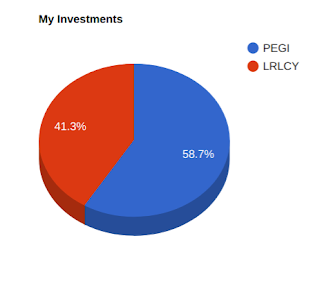
In the long-term, I invested much more on PEGI. This is what the total performance of my investments looks like:

RS, My Investments.
The ROI of my portfolio’s compared to the S&P 500 looks something like this:

Evidently, the ROI of the S&P 500 is considerably more than that of my portfolios’. However, I believe I have reached larger goals with these investments that an ROI. Through these investments, besides meeting my financial goals I am supporting two companies which I feel have something most companies can learn from: both distinguish themselves in one way or another by how they apply their ethics in their doings.
These are the assumptions I made in this Action Project:
- I am assuming in my calculations that both L’Oreal and Pattern Energy will continue to be leaders in their markets because of their continuous growth, their quality and the type of service they provide.
- I am assuming that that even though Pattern Energy’s performance hasn’t been the best on average in the last 5 years, it will grow much more, as it has been doing in the last year.
- I am also assuming that both Pattern Energy and L’Oreal highlight more than most or even rather all other companies in their markets for financial, ethic, and productive reasons.
Tuesday, January 2, 2018
The Chakra of the Artisan: Alternative Food & Other Goods on Santa Cruz Island
I am studying a course called “Journalism”, and this is my 3rd and last Action Project. For this Action Project I had to cover an event with a “spot” story, using the tools I have acquired during the course as a whole, such as objectivity and the inverted pyramid of journalism, among many others.
In this 3rd Unit I learned about some of the essential skills and concepts of written-journalism, specifically in the present century. I also learned about some of the values written-journalism has, and about how it has certain advantages that cannot be found in any other form of journalism.
I chose to report on the “Chakra of the Artisan”, a farmer’s market hosted once a month in Bellavista, Santa Cruz Island, Galapagos. I chose this event because it seemed to me like an interesting initiative; after all, there are only a handful of farmers markets on the Island. My brother and I were also asked to play music at the event, and that sounded fun!
This was my first time covering an event as a journalist, which made it all the more interesting. I was impressed about how much more I ended up discovering about an event when I looked at it from a journalistic point of
In this 3rd Unit I learned about some of the essential skills and concepts of written-journalism, specifically in the present century. I also learned about some of the values written-journalism has, and about how it has certain advantages that cannot be found in any other form of journalism.
I chose to report on the “Chakra of the Artisan”, a farmer’s market hosted once a month in Bellavista, Santa Cruz Island, Galapagos. I chose this event because it seemed to me like an interesting initiative; after all, there are only a handful of farmers markets on the Island. My brother and I were also asked to play music at the event, and that sounded fun!
This was my first time covering an event as a journalist, which made it all the more interesting. I was impressed about how much more I ended up discovering about an event when I looked at it from a journalistic point of
Thursday, November 16, 2017
"In Re: "Silvio Rodriguez & Change" Podcast
I am studying a course called “Journalism”, and this is my second Action Project. For this Action Project, I had to record and edit a Podcast that would tell the story of a representative voice of the 20th Century. I decided my Podcast would revolve around Silvio Rodriguez, a Cuban singer, guitarist ,composer, and poet.
Silvio Rodriguez is often referred to as the best singer and songwriter of Central and South America, and his general work is considered a classic from the 20th Century. In this Podcast, I am telling the story of how Silvio Rodriguez’s voice has the ability to make people grow, especially in the Latin American population. I display this story though the stories of two friends of mine who come from two different places and cultures in Latin America, but who deeply enjoy Silvio Rodriguez’s music and feel enriched by it.
I consider this story to be newsworthy mainly because I have never heard of this story being told before. Silvio is often referenced as a symbol of the Cuban Revolution and Latin American Left, which makes a great part of the Latin American population to ignore or not appreciate his art. But I believe that Silvio’s art, even though it does have a political affiliation, transcends the purely political and rather is in essence, a call for a positive change, both individually and collectively, which I think is a human necessity and a common denominator in persons of all ages.
Silvio Rodriguez is often referred to as the best singer and songwriter of Central and South America, and his general work is considered a classic from the 20th Century. In this Podcast, I am telling the story of how Silvio Rodriguez’s voice has the ability to make people grow, especially in the Latin American population. I display this story though the stories of two friends of mine who come from two different places and cultures in Latin America, but who deeply enjoy Silvio Rodriguez’s music and feel enriched by it.
I consider this story to be newsworthy mainly because I have never heard of this story being told before. Silvio is often referenced as a symbol of the Cuban Revolution and Latin American Left, which makes a great part of the Latin American population to ignore or not appreciate his art. But I believe that Silvio’s art, even though it does have a political affiliation, transcends the purely political and rather is in essence, a call for a positive change, both individually and collectively, which I think is a human necessity and a common denominator in persons of all ages.
Tuesday, October 17, 2017
College Preparation
I am studying a course called “Economics”, and this is my first Action Project. For this project, I had to weigh all the pros and cons of going to college by developing an elaborate investigation to learn the “true” cost of college, and deciding whether it would be worth attending. I must admit that this project put me face to face with a series of questions which I was putting off, but needed to answer. I am most proud of the fact that even if I don’t end up picking the carrier I chose for this action project, I have a much bigger picture and further understanding of all the things I need to take in consideration when making a budget for my college preparation, as well as all the things I need to have clear before choosing a College as a future option.
I’d like to study Music Production & Engineering in Berklee College of Music, in Boston, MA
I like the Music Production & Engineering carrier Berklee offers precisely because it provides knowledge in both Music Production and Music Engineering, which may sound the same but are different lines of work. Music Producers usually are the “managers” of a recording, making sure things such as the creation of a record and the logistics where it will be recorded are planned out neatly, as well as working with the musician by making sure the exact sound the musician wants for his record is achieved. The music engineer, on the other hand, works on all the technical side of the creation of a record.
When studying music engineering, you learn many basic and complex principles that may be applied in other lines of work, such as media production, engineering sound for live performances, etc. I consider music engineering to be especially valuable, because it broadens my working possibilities in the future. It also gives me a baseline that might permit me to choose my future specialization studies in a wise way. I am not sure what I’d like my occupation to be in the future yet, but both music production and media engineering are jobs that interest me.
For this Action Project, however, I chose my future profession as a music producer.
I believe media is a very powerful weapon in all its different forms. Everyday, media we listen to and watch tell us how we should dress, talk, behave, etc. Most of the time, media influences us in negative ways. I ask myself, what would happen if we were to use media, in all its different forms and expressions, to influence in positive ways only? Surely wonders!
I’ve had the amazing opportunity to serve in projects whose whole mission is to experiment on how to use media to influence in positive ways, and these experiences have helped me realize that those of us who use media to express an idea, such as music in my case, must be aware of its immense potential and power. Therefore, I’d like to study music production and engineering to experiment and make a living off of making music that may influence positively to as wide as a group as possible!
For this Action Project I created a presentation where I further developed the case scenario of studying in Berklee. All the investigations and calculations I did reinforced in me the social argument that states that attending college is a great decision, and a possible one.
I’d like to study Music Production & Engineering in Berklee College of Music, in Boston, MA
I like the Music Production & Engineering carrier Berklee offers precisely because it provides knowledge in both Music Production and Music Engineering, which may sound the same but are different lines of work. Music Producers usually are the “managers” of a recording, making sure things such as the creation of a record and the logistics where it will be recorded are planned out neatly, as well as working with the musician by making sure the exact sound the musician wants for his record is achieved. The music engineer, on the other hand, works on all the technical side of the creation of a record.
When studying music engineering, you learn many basic and complex principles that may be applied in other lines of work, such as media production, engineering sound for live performances, etc. I consider music engineering to be especially valuable, because it broadens my working possibilities in the future. It also gives me a baseline that might permit me to choose my future specialization studies in a wise way. I am not sure what I’d like my occupation to be in the future yet, but both music production and media engineering are jobs that interest me.
For this Action Project, however, I chose my future profession as a music producer.
I believe media is a very powerful weapon in all its different forms. Everyday, media we listen to and watch tell us how we should dress, talk, behave, etc. Most of the time, media influences us in negative ways. I ask myself, what would happen if we were to use media, in all its different forms and expressions, to influence in positive ways only? Surely wonders!
I’ve had the amazing opportunity to serve in projects whose whole mission is to experiment on how to use media to influence in positive ways, and these experiences have helped me realize that those of us who use media to express an idea, such as music in my case, must be aware of its immense potential and power. Therefore, I’d like to study music production and engineering to experiment and make a living off of making music that may influence positively to as wide as a group as possible!
For this Action Project I created a presentation where I further developed the case scenario of studying in Berklee. All the investigations and calculations I did reinforced in me the social argument that states that attending college is a great decision, and a possible one.
Monday, September 25, 2017
The Meaning Of Life Through Roslyn's Eyes
I am studying a course called Journalism and this is my first Action Project. In this first unit I focused on photojournalism; studying iconic photographs that have been the images that in many cases represented remarkable events in world history, and learning to identify what it was that made them what they were. I also studied deeply about the purpose behind journalism itself, as well as objectivity, its importance and the means through which we can achieve it. I also learned about the basics of photography.
For this Action Project I had to portray someone’s meaning of life in one portrait and 1000 words.I portrayed Roslyn Cameron, Galapagos Development Officer for Galapagos Conservancy. She is 58 years old, and was born in South Australia. I photographed/interviewed Roslyn on Monday, September 18th, 2017 at her office at the Galapagos Conservancy headquarters, on Santa Cruz Island.
I decided to photograph/interview Roslyn because, as she put it, I had a journalistic “hunch”. I had only met her briefly during a couple of social meetings; and to be truthful, I barely knew much about her. But there was something that seemed very interesting to me; she has lived in the Galapagos Islands for the last 30 years of her life. It felt to me as if the main reason behind her decision to stay here for so long must have been one that transcended many things, including both work and economic status. This made me very curious.
I also felt to me as if the meaning she gave to her life must have been strongly linked with the fact that she lives in these Islands, so far from her homeland. For this reason, I decided to introduce the topic of the meaning of life on questions related to why she lived here.
...................................................................................................................................................................

For this Action Project I had to portray someone’s meaning of life in one portrait and 1000 words.I portrayed Roslyn Cameron, Galapagos Development Officer for Galapagos Conservancy. She is 58 years old, and was born in South Australia. I photographed/interviewed Roslyn on Monday, September 18th, 2017 at her office at the Galapagos Conservancy headquarters, on Santa Cruz Island.
I decided to photograph/interview Roslyn because, as she put it, I had a journalistic “hunch”. I had only met her briefly during a couple of social meetings; and to be truthful, I barely knew much about her. But there was something that seemed very interesting to me; she has lived in the Galapagos Islands for the last 30 years of her life. It felt to me as if the main reason behind her decision to stay here for so long must have been one that transcended many things, including both work and economic status. This made me very curious.
I also felt to me as if the meaning she gave to her life must have been strongly linked with the fact that she lives in these Islands, so far from her homeland. For this reason, I decided to introduce the topic of the meaning of life on questions related to why she lived here.
...................................................................................................................................................................
Roslyn believes that we are not always born in the place where we can best develop our potential. Given that traveling is much easier now, more and more people get to find the place for their best growth.
“Australia was not that place for me. I am a woman; born at a time when women still didn’t have rights, when aborigines didn’t have rights, when we were still very much under colonial rule. You didn't educate girls, you didn’t send them to university; what a waste they are only going to marry and have babies!”
“Australia was not that place for me. I am a woman; born at a time when women still didn’t have rights, when aborigines didn’t have rights, when we were still very much under colonial rule. You didn't educate girls, you didn’t send them to university; what a waste they are only going to marry and have babies!”
By living in the Galapagos Islands, Roslyn transcends social, familial, and cultural constraints that limit intellectual and spiritual growth. She receives constant mental stimulation through her work, and the conversations with the never ending opportunities to talk to the occasional scientist studying iguana intestines or the tourist who’s a Stanford Professor studying human behaviour genetics. Roslyn also values communities that understand, merit, and benefit from differences. She believes that Galapagos, as a generalization, is just that, where cultural differences collide and meld.
Coming to live in these Islands was certainly not something she had planned. When she described how she came to live here, she mentioned that “...I don’t believe in luck, but it was the right time and the right place”. Roslyn believes in life paths, and that people and places are brought together at an important time in their development. This is Galapagos for her.
Roslyn is also a single, devoted mother. She has a colored child, and for her the thought of raising her child in Australia was simply unacceptable. The Australia of her youth was only recently repealing the White Australia migration policy, which restricted migration based on skin colour. And this was the Australia she knew.
“Those are my memories of the Australia I grew up in, which may or may have not been true 25 years later… This is something that probably only a mother would understand.. On becoming pregnant the thought flooded through me that my child needed to be raised in Galapagos. He could have been as white as I am, but the minute I knew I was pregnant instinctively I knew he had to be raised in Galapagos.”
Coming to live in these Islands was certainly not something she had planned. When she described how she came to live here, she mentioned that “...I don’t believe in luck, but it was the right time and the right place”. Roslyn believes in life paths, and that people and places are brought together at an important time in their development. This is Galapagos for her.
Roslyn is also a single, devoted mother. She has a colored child, and for her the thought of raising her child in Australia was simply unacceptable. The Australia of her youth was only recently repealing the White Australia migration policy, which restricted migration based on skin colour. And this was the Australia she knew.
“Those are my memories of the Australia I grew up in, which may or may have not been true 25 years later… This is something that probably only a mother would understand.. On becoming pregnant the thought flooded through me that my child needed to be raised in Galapagos. He could have been as white as I am, but the minute I knew I was pregnant instinctively I knew he had to be raised in Galapagos.”
Roslyn believes that part of the meaning of life is the constant search for truth. The everlasting quest for knowledge and understanding. And Galapagos is a unique place which offers her an environment where living up to this ideal is possible.
Slowly the topic on the meaning of life began to take form in the interview as we explored more deeply through conversation and a few basic questions. At first Roslyn pointed out that the meaning of life sometimes changes with the decades. For example, she recalled that when she was my age (17), her life expectations were very much molded by the political situations of the time. Had a lot of social reform movements not happened in Australia in the 1970’s, she believed that she certainly wouldn’t be sitting with me here in the Galapagos Islands.
“There is liberation in the changing of decades that also allows you to speculate what your life path might be, or the meaning of life.”
Slowly the topic on the meaning of life began to take form in the interview as we explored more deeply through conversation and a few basic questions. At first Roslyn pointed out that the meaning of life sometimes changes with the decades. For example, she recalled that when she was my age (17), her life expectations were very much molded by the political situations of the time. Had a lot of social reform movements not happened in Australia in the 1970’s, she believed that she certainly wouldn’t be sitting with me here in the Galapagos Islands.
“There is liberation in the changing of decades that also allows you to speculate what your life path might be, or the meaning of life.”
However, she believed that as much as her meaning of life had changed over the decades, the core had always remained the same.
“The meaning of life for me has been about the pursuit of happiness. Not happiness itself but about the challenges the path and everything else along the way. Happiness is that sense of calm that you’re doing your best and no matter what is going to happen- maybe it’ll happen the way you wanted it to, maybe it won’t -but that there’s a flow to what’s happening.”
“The meaning of life for me has been about the pursuit of happiness. Not happiness itself but about the challenges the path and everything else along the way. Happiness is that sense of calm that you’re doing your best and no matter what is going to happen- maybe it’ll happen the way you wanted it to, maybe it won’t -but that there’s a flow to what’s happening.”
Some people have religious support to that theory, but she wasn’t raised in a religious culture. “I don’t like to label the feeling” she said, “but there’s something bigger than me and I have a role to play”. Roslyn has traveled over the years, and she’s got Jewish, Buddhist, Chinese Buddhist, Atheist, Catholic friends, and many more. And she believes that the basic principles of all religions are the same. It’s about being a decent human being, doing the right thing for yourself, for your family and for your community. Roslyn was also raised with country values. You don’t steal from the neighbour, you don’t talk badly about the neighbour, as well as many other familiar, social, and cultural structures that are very ingrained in her.
Roslyn was raised by two very different family structures. She described her mother’s family as working class white that intermarried with people of aboriginal descent. So she grew up with mixed race people that were her cousins and aunts, and that itself set her apart from most Australians. Her father’s side was very cultured; her grandmother, which she described as her biggest influence on her father’s side, came from a wealthy family . She was educated and sophisticated, and everything she did was immaculate.
Her father was a policeman and one of the good ones. He would go to work everyday to protect and help the community. So Roslyn was raised to investigate, to be aware, to verify. Growing up her career trajectory was forensic science or law but for a “whole bunch of silly circumstances during high school, it just didn’t happen”.
“But that’s where my skill base lies, and so it’s in me to verify. It’s in me to double-check things, it’s in me to memorize certain things and ask ‘are you sure Raji? Did you check that?’ ”
Roslyn was raised by two very different family structures. She described her mother’s family as working class white that intermarried with people of aboriginal descent. So she grew up with mixed race people that were her cousins and aunts, and that itself set her apart from most Australians. Her father’s side was very cultured; her grandmother, which she described as her biggest influence on her father’s side, came from a wealthy family . She was educated and sophisticated, and everything she did was immaculate.
Her father was a policeman and one of the good ones. He would go to work everyday to protect and help the community. So Roslyn was raised to investigate, to be aware, to verify. Growing up her career trajectory was forensic science or law but for a “whole bunch of silly circumstances during high school, it just didn’t happen”.
“But that’s where my skill base lies, and so it’s in me to verify. It’s in me to double-check things, it’s in me to memorize certain things and ask ‘are you sure Raji? Did you check that?’ ”
She believes that because of this innate skill her meaning of life is related to verifying things, hoping to make other people think beyond the obvious, and sharing whatever it is she finds out, or knows. Storytelling.
...................................................................................................................................................................

This is a photograph I took of Roslyn right after our interview outside her office. I asked her if she had any suggestions concerning the portrait I was going to shoot and she reminded me of the power of expression of our eyes with the phrase, “The eyes are the windows to the soul”. I find that phrase very convincing because I know for certain that eyes can tell us a lot about what a person is really feeling, as well as give hints related to a person’s personality. I decided to shoot it in black & white because I wanted to highlight the sharp, piercing and deep look her eyes transmit, rather than the color of her skin, eyes, and hair as well as her age, which can be perceived much easier in color.
I shot this photograph with my smartphone (HTC One). The main focus is set on the eye. It was noon when I shot this photograph, and the sun was blazing. I set the aperture of the camera rather low, as well as the shutter-time, permitting me to take the photo in back light and making sure the photograph doesn’t get blurry from the movement of Roslyn’s hair from the breeze. Roslyn’s eye is also set on the left vertical line in the imaginary grid, centered right between the two horizontal lines. Roslyn’s skin, as well as the detail in both her eyelashes and her eye add texture to the photograph, as well as the blurry trees in the background.
The only manipulation I did to the photograph after shooting it was cropping it a bit closer to the eye, removing a small portion of the beginning of the nose which was present in the original photograph.
Tuesday, August 15, 2017
How Can I Reduce The Ecological Footprint Of My Home?
I am studying a course called “Urban Planning”, and this is my second Action Project. This Project is about designing my own energy-efficient electrical plan for my house.This Unit was about electricity, and about how, when used effectively, it can do wonders. I learned about AC and DC power systems, about how humans linked lightning to electricity thanks to Benjamin Franklin, and about circuits, volts, amps, resistance, among other principles.
For this Action Project, I had to: sketch a circuit diagram, construct my circuit representation, build a case to house my diagram, connect my circuit to real energy-efficient solutions, calculate my design's impact, and explain my eco-friendly plan.
However, I began encountering problem after problem in the process of developing this Action Project. First of all, there isn’t a detailed hardware store where I live (Galapagos Islands) where I could buy the materials I needed, and so I had to find my materials through other means. I spent several days riding my bike around town, asking people where I could find resistors and small LED lights. I finally arrived upon an electrical recycling shop a nice man owned, who I became friends with. He gave me a piece of a broken TV where I could retrieve both resistors and LED lights. These materials however, weren’t working so well. Some of the resistors I retrieved weren’t exactly functioning the way they should’ve, and they also weren’t quite the ones I needed.
Also, I needed technical assistance on how to use materials such as the soldering iron, etc. There is a teacher from the school where my Dad is Principal who was willing to help me, but he is usually very busy and can only offer small periods of time per day.
Given the circumstances, I decided to propose to my teachers an alternative Action Project. A co-worker of my dad’s and great friend of mine, Reina Oleas, owns what I believe to be the first and only completely self-sustainable house in the history of Ecuador. She decided to set this project up on her own with the help of her family. Now, given that she lives on the Galapagos islands (there is absolutely no history of anyone trying to set up a project here similar to hers, and therefore no architects that could help or no market to buy from), she had to engineer most of her house on her own. She uses all of the natural resources (sun, rain, wind, etc) that predominate in the region where she lives to make her house work, while her house is connected to no cable and no pipe. She also had to engineer her whole electrical system!
I proposed that my action project be to interview Reina and to focus mainly on her whole electrical system engineering process, to finally think about how I can apply some of the principles she used on my own house. And my teachers agreed!
And so I began developing my proposed Action Project. I told Reina about my proposal to my teachers, and she told me she would be marveled to help. However, she said that if I wanted to focus mainly on the whole electrical system of her house and the journey to fully develop it as it is seen today, I would have to talk to her husband, Mr. Roberto Plaza, given that he was the one in charge of that part of the project. Roberto works as a guide for tourists that come to the Galapagos Island in search for knowledge about these wonderful islands, and has a very busy schedule were he leaves on tourists boats that voyage around the islands for weeks at a time. Thankfully, I managed to contact him and he was only hours from embarking yet again to another tourist trip! He agreed on interviewing him while on his way to being embarked.
I interviewed him for about 30 minutes, and I asked him mostly about his experience in designing his own electrical plan.
He told me that, as they were working on their project to build their energy-efficient house, they realized that the predominant renewable resource they could retrieve electricity from was solar energy. Once they figured that out, they began planning how to install solar panels in their house. They got in contact with several companies from Quito, Ecuador’s capital, and finally agreed on employing one that seemed to fit best. However, they decided to to try installing the solar panels on a smaller house they had, as an experiment to see if this company’s job was efficient.
Once the company had finished their job on the smaller house, they moved into that house to try it out. 24 hours later the power went out, and it never came back. Apparently, the company had made a very basic mistake, and refused to accept that they had done so. The problem was, the Plaza family didn’t face much of a choice, because very few companies offer their services on the Galapagos Islands, and from those few the one they had already employed was by far the best. Also, given that the company had to import all of their material (there is no solar panel manufacturing company in Ecuador), send it all to the Galapagos Islands, and send people to install them, it was very expensive. Roberto contemplated all of these difficulties, and finally decided something that would mark a turning point in the project: He would learn how to design the whole electrical plan for the house and install the solar panels on his own, as well as learn how to provide maintenance. His main sources of knowledge in this process were a great friend of his who accompanied him throughout the whole proceeding and led him to friends who worked on the solar panel business and knew about how to install them, the internet, and a handbook called “Dimensionar tu equipo solar de acuerdo a tus necesidades” (Fashion your solar equipment according to your needs). With these 3 tools, he gradually learned and developed an electrical plan for his home. He realized that the amount of solar panels they needed to buy relied a lot on the type of appliances they were going to use, especially the ones that created heat. He told me about a very cool exercise he did with his family were they all sat together and made a personal plan of the amount of electricity they needed per day. They realized that most of the electricity they used came from appliances that could be substituted by more efficient ones. Something that I feel like makes this exercise very cool is that through it everyone became aware of the amount of electricity they needed, which is not always the amount of electricity we use.
Thus, they got rid of the toaster, the waffle maker, the coffee maker, etc. and found substitues such as the manual coffee maker. Another amazing thing that permitted them to reduce the amount of electricity they used was to take advantage of the wind regarding the architecture to control the temperature of the house. Most of the windows face the side of the house from where the wind comes from, and that way the wind keeps the house cool. However, when it gets a little too cool, you can control the temperature by closing some windows. Thus, the Plaza’s don’t use any air conditioners.
Also, the property in which the house is built is in the high (altitude) part of the island, where it's humid all of the time. Most of the other families that live in the area use de-humidifiers. However, the Plaza’s investigated and found a Chinese method which consists on a series of ventilation chambers placed below the house that permit air to flow below the house, not letting the humidity rise from the ground and reducing it by 20%. Thus, the Plaza’s don’t use any de-humidifiers.
The decided on an estimate of the amount of electricity they needed per day and bought the number of solar panels and batteries that would fit the description.
With the help of the 3 tools I mentioned earlier, Roberto installed the solar panels and batteries, and has given them maintenance ever since. With all the changes they made as a family to reduce the amount of electricity they use on a daily basis, Roberto was profoundly proud to express to me that if you were to turn on all of the lights and all of the appliances of his house at once, you’d be using the equivalent amount of energy of one average air conditioner. He also told me something that he proved in the development of this project: if any family decides to use only the amount of electricity they need, and substitute their appliances for other more eco-friendly ones, they can reduce up to half of the amount of electricity they were previously using. He says that even if you don’t decide to use natural resources to power your house such as solar panels, only re-thinking the way you are using electricity can drastically change your electricity bills and your ecological footprint.
From all of the amazing things this experience has taught me, I will apply in my own home:
I learned so much from this experience and am very thankful to my school for permitting me to develop an idea I had in mind into an Action Project.
For this Action Project, I had to: sketch a circuit diagram, construct my circuit representation, build a case to house my diagram, connect my circuit to real energy-efficient solutions, calculate my design's impact, and explain my eco-friendly plan.
However, I began encountering problem after problem in the process of developing this Action Project. First of all, there isn’t a detailed hardware store where I live (Galapagos Islands) where I could buy the materials I needed, and so I had to find my materials through other means. I spent several days riding my bike around town, asking people where I could find resistors and small LED lights. I finally arrived upon an electrical recycling shop a nice man owned, who I became friends with. He gave me a piece of a broken TV where I could retrieve both resistors and LED lights. These materials however, weren’t working so well. Some of the resistors I retrieved weren’t exactly functioning the way they should’ve, and they also weren’t quite the ones I needed.
Also, I needed technical assistance on how to use materials such as the soldering iron, etc. There is a teacher from the school where my Dad is Principal who was willing to help me, but he is usually very busy and can only offer small periods of time per day.
Given the circumstances, I decided to propose to my teachers an alternative Action Project. A co-worker of my dad’s and great friend of mine, Reina Oleas, owns what I believe to be the first and only completely self-sustainable house in the history of Ecuador. She decided to set this project up on her own with the help of her family. Now, given that she lives on the Galapagos islands (there is absolutely no history of anyone trying to set up a project here similar to hers, and therefore no architects that could help or no market to buy from), she had to engineer most of her house on her own. She uses all of the natural resources (sun, rain, wind, etc) that predominate in the region where she lives to make her house work, while her house is connected to no cable and no pipe. She also had to engineer her whole electrical system!
I proposed that my action project be to interview Reina and to focus mainly on her whole electrical system engineering process, to finally think about how I can apply some of the principles she used on my own house. And my teachers agreed!
And so I began developing my proposed Action Project. I told Reina about my proposal to my teachers, and she told me she would be marveled to help. However, she said that if I wanted to focus mainly on the whole electrical system of her house and the journey to fully develop it as it is seen today, I would have to talk to her husband, Mr. Roberto Plaza, given that he was the one in charge of that part of the project. Roberto works as a guide for tourists that come to the Galapagos Island in search for knowledge about these wonderful islands, and has a very busy schedule were he leaves on tourists boats that voyage around the islands for weeks at a time. Thankfully, I managed to contact him and he was only hours from embarking yet again to another tourist trip! He agreed on interviewing him while on his way to being embarked.
I interviewed him for about 30 minutes, and I asked him mostly about his experience in designing his own electrical plan.
He told me that, as they were working on their project to build their energy-efficient house, they realized that the predominant renewable resource they could retrieve electricity from was solar energy. Once they figured that out, they began planning how to install solar panels in their house. They got in contact with several companies from Quito, Ecuador’s capital, and finally agreed on employing one that seemed to fit best. However, they decided to to try installing the solar panels on a smaller house they had, as an experiment to see if this company’s job was efficient.
Once the company had finished their job on the smaller house, they moved into that house to try it out. 24 hours later the power went out, and it never came back. Apparently, the company had made a very basic mistake, and refused to accept that they had done so. The problem was, the Plaza family didn’t face much of a choice, because very few companies offer their services on the Galapagos Islands, and from those few the one they had already employed was by far the best. Also, given that the company had to import all of their material (there is no solar panel manufacturing company in Ecuador), send it all to the Galapagos Islands, and send people to install them, it was very expensive. Roberto contemplated all of these difficulties, and finally decided something that would mark a turning point in the project: He would learn how to design the whole electrical plan for the house and install the solar panels on his own, as well as learn how to provide maintenance. His main sources of knowledge in this process were a great friend of his who accompanied him throughout the whole proceeding and led him to friends who worked on the solar panel business and knew about how to install them, the internet, and a handbook called “Dimensionar tu equipo solar de acuerdo a tus necesidades” (Fashion your solar equipment according to your needs). With these 3 tools, he gradually learned and developed an electrical plan for his home. He realized that the amount of solar panels they needed to buy relied a lot on the type of appliances they were going to use, especially the ones that created heat. He told me about a very cool exercise he did with his family were they all sat together and made a personal plan of the amount of electricity they needed per day. They realized that most of the electricity they used came from appliances that could be substituted by more efficient ones. Something that I feel like makes this exercise very cool is that through it everyone became aware of the amount of electricity they needed, which is not always the amount of electricity we use.
Thus, they got rid of the toaster, the waffle maker, the coffee maker, etc. and found substitues such as the manual coffee maker. Another amazing thing that permitted them to reduce the amount of electricity they used was to take advantage of the wind regarding the architecture to control the temperature of the house. Most of the windows face the side of the house from where the wind comes from, and that way the wind keeps the house cool. However, when it gets a little too cool, you can control the temperature by closing some windows. Thus, the Plaza’s don’t use any air conditioners.
Also, the property in which the house is built is in the high (altitude) part of the island, where it's humid all of the time. Most of the other families that live in the area use de-humidifiers. However, the Plaza’s investigated and found a Chinese method which consists on a series of ventilation chambers placed below the house that permit air to flow below the house, not letting the humidity rise from the ground and reducing it by 20%. Thus, the Plaza’s don’t use any de-humidifiers.
The decided on an estimate of the amount of electricity they needed per day and bought the number of solar panels and batteries that would fit the description.
With the help of the 3 tools I mentioned earlier, Roberto installed the solar panels and batteries, and has given them maintenance ever since. With all the changes they made as a family to reduce the amount of electricity they use on a daily basis, Roberto was profoundly proud to express to me that if you were to turn on all of the lights and all of the appliances of his house at once, you’d be using the equivalent amount of energy of one average air conditioner. He also told me something that he proved in the development of this project: if any family decides to use only the amount of electricity they need, and substitute their appliances for other more eco-friendly ones, they can reduce up to half of the amount of electricity they were previously using. He says that even if you don’t decide to use natural resources to power your house such as solar panels, only re-thinking the way you are using electricity can drastically change your electricity bills and your ecological footprint.
From all of the amazing things this experience has taught me, I will apply in my own home:
- I’ll tell my family about the exercise the Plaza family did to analyze the amount of electricity they were using and the amount they needed, and I will persuade them to try it out. As a result of this exercise, I will consult with my family about which appliances we can substitute or give away.
- My house has some installed solar panels which haven’t been mantained in a long time and are currently not in use; I will ask Roberto to take a look at them and if possible help me with making a budget of how much money and effort it would take to make them work again.
- We are in the cooler months of the year, and therefore never use fans in my house, but I will locate the direction from where the wind comes from, and find ways to take advantage of it to keep the house cool in the warmer months of the year (December through May).
- I will make a budget of how much it would cost to change the light bulbs in my house for LED lights.
I learned so much from this experience and am very thankful to my school for permitting me to develop an idea I had in mind into an Action Project.
Subscribe to:
Posts (Atom)