Monday, June 4, 2018

Music and Productivity in the Senior Class

From my Systems & Models course, this is my second AP. In this unit we learned a lot about how people interact with other people, and about how individuals can mold a collective space, as well as how collective behaviors can mold individuals as well.  We also dived into the different patterns and behaviors in groups that tend to lead to either breakdowns or breakthroughs. This lead us to reflect about the social groups we are part of and the patterns they follow. For this Action Project we had to run a scientific experiment based on group observation to further explore any given topic we’d like to know about how people interact. I chose to run a experiment that addressed the following guiding question: How does the way we(students) listen to music while working affect our productivity?

Experiment Details

Taking advantage of the fact that I am visiting GCE Lab School in Chicago, I decided to do this experiment with my classmates and our teachers. There are a total of nine students in the Senior Year, and all teachers in GCE have at one point or another taught senior year, which sums up to five teachers

I created two surveys, one to be taken by students and one to be taken by teachers. The student’s survey was a series of questions that challenged them to think about what they believed to be the most productive way of listening to music while studying, in different scenarios such as in class or at home. The teacher's survey revolved around the experience they’ve had with the present senior class, with questions that would challenge them to think about the different ways students interact with music and, based on their observance, which way they believed to to be most productive.

 RS, Senior GCE class, 2018.
 RS, Senior GCE class, 2018.

Hypothesis

I believe that even though most students think that they can concentrate better when listening to music with their earphones, the results will show through the teacher’s overall observance that students are most productive when they listen to music with a speaker.

Research

In order to have a bit of context as to what the world already knows about the topic I chose for my experiment, I did some research on how music affects individuals in the workplace in general. Studies show that music can boost your productivity when the type of music is in harmony with the given type of work or scenario. Songs with lyrics, for example, or songs with more complex musical structure tend to reduce productivity when the given task requires critical thinking. However, other studies such as a study from the University of Helsinki  note that the simple act of listening to music while in class can help improve students’ memory and learning capacity. There is also evidence that shows that music played at low volumes during class activities can boost creativity and concentration. 

I also found some interesting studies about how listening to music with headphones often becomes a social barrier in the workplace. The use of headphones in the workplace was cited as a major office-etiquette problem in a 2010 survey of 1,400 chief information officers by Robert Half Technology.  Social dynamics are very important in a classroom; even in individual work some teachers from GCE Chicago expect their students to socialize and compare their coursework to arrive to a richer conclusion. Therefore, it can be inferred that listening to music with earphones in the classroom can sometimes be counterproductive.

Data from experiments

I received a total of seven surveys completed by students, and five surveys completed by teachers. The results were as shown:

Student’s Survey

When I asked students whether they preferred listening to music with earphones, with a general speaker, or not listening to music at all, 62.5% of them preferred earphones, 25% preferred no music at all, and only 12.5% preferred using a speaker.

Forms response chart. Question title: When you want to concentrate on your work in the classroom, do you prefer listening to music with earphones, with a general speaker, or not listening to music at all? . Number of responses: 8 responses.
When the scenario was changed to schoolwork at home though, the response was very different. 50% of the students preferred using a speaker at home, 37.5% preferred no music at all, and only 12.5% preferred using earphones. 

Forms response chart. Question title: When you want to concentrate on your schoolwork at home, do you prefer listening to music with earphones, with a general speaker, or not listening to music at all?. Number of responses: 8 responses.
The type of music heard while studying was generally varied, and most students heard the same music genres for all types of schoolwork, disregarding what the schoolwork implied you to do. 

Teacher’s Survey

Teachers agreed that listening to music with earphones can be distracting, on average, 51% of the time, compared to the average of 11% distraction when a speaker is used in class (with a low volume.) 

The most popular music genre played by teachers in class is classical, though many vary depending on the task at hand. When students are doing quiet independent work like writing or drawing, some teachers use mellow rhythms and instrumental music to encourage students to focus. However, when students are working on a project or in groups, teachers often use different genres such as pop and rock. A very small percentage of teachers prefer not using music in class in any way.
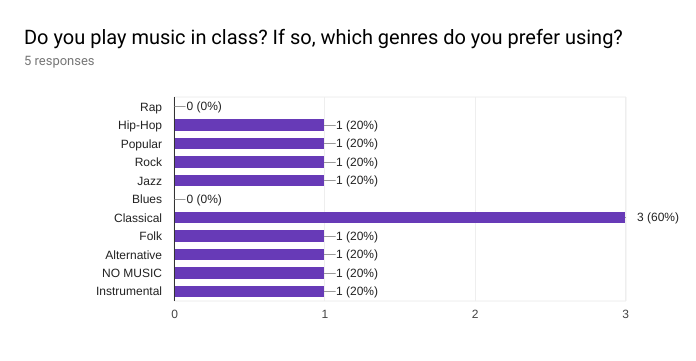
Forms response chart. Question title: Do you play music in class? If so, which genres do you prefer using?. Number of responses: 5 responses.
Analysis When comparing the student’s most popular ways of listening to music while working at school and at home, the data suggests that most students use earphones in the classroom to block out noises such as chattering, laughing, etc, though perhaps prefer using a speaker while working alone. This is especially conflicting because even though students use earphones with the intention of isolating themselves and reaching higher levels of concentration, most teachers agree that this is the most distracting music-listening technique. Teacher’s data also generally suggests that listening to genres that go well with the task at hand are most likely to rise productivity levels in students. Conclusion A major problem in class is that there are many distracting noises that prevent students from concentrating, especially when the given task involves quiet, independent work. Most students then resort to plugging their earphones in to block out the noise, but the data suggest that this is mostly counterproductive and clearly not a solution. On the other hand, hearing music with a speaker, both in class in at home, especially with a low volume and music that is in harmony with the given type of schoolwork, has been proved to help students concentrate and be generally more productive.

CITATIONS

The Wall Street Journal, “At Work, Do Headphones Really Help?”, June 7, 2012.
https://www.wsj.com/articles/SB10001424052702303395604577432341782110010  


Inc., “Listening To Music While Doing Homework: Is It A Good Idea?”, December 12, 2017
https://www.inc.com/melissa-chu/research-shows-listening-to-music-increases-produc.html  

The University of Scranton, “ Music in the Classroom Proves Beneficial for Learning”, 2017.
https://www.uscranton.com/resources/teaching-tips/music-in-the-classroom-proves-beneficial-for-learning/#.WxBo3EiUu3A 

Wednesday, May 16, 2018

The Universal Declaration of Human Rights: Revised

I am studying a course called Equality, and this is my first Action Project. In this unit we studied about the principle of citizenship and of how its definition has transformed (and continues to transform) in time. We learned about this concept by studying the arguments and actions of thinkers in history such as Aristotle, and finally crafted our own conception of the matter. We also reviewed and questioned two main human rights declarations: The Universal Declaration of Human Rights and the Bill of Rights. For this Action Project we had to craft our own declaration of human rights with the guidance of our concept of citizenship, addressing a specific issue we believe to be controversial. I believe my declaration is important and necessary because it offers a unique perspective on citizenship that confronts the prejudices that affect our world arising from divisionary and discriminatory barriers.

Citizenship is a very interesting term; its true definition and purpose has been debated directly and indirectly through official constitutions and other documents throughout history. My approach to citizenship is deeply intertwined with a concept I like to call “double moral purpose.” In order for humanity to truly progress, all world citizens must be imbued in a purpose that impulses them to transform individually as well as contribute to the transformation of society.

I believe that a true and coherent definition of citizenship must include primarily all the peoples of the world. I arrived to this conclusion from the realization that norms and modes of individual behavior determine the social environment, and are shaped at the same time by social structures and processes. Therefore, if citizenship does not apply to a certain group of individuals, and are consequently deprived of the laws that protect others who citizenship does apply to, the overall collective advancement of that community is hindered.

 Thus, if a specific group of persons is suffering, the whole world is being collectively affected by it, once again, hindering its advancement.

Furthermore, I have also come to the conclusion that the subtle forms of self-interest and self-centeredness that all independent countries tend to adopt comes from the lack of direct exterior interaction and of assuming global goals. They lack of standards to judge their own progress, and it is then that they eventually forget the social dimension that comes hand-in-hand with a sense of purpose, falling into arrogance and self-satisfaction.

In my project I decided to revise the Universal Declaration of Human Rights (UDHR). My biggest concern, however,  did not lie in the existing articles of the present UDHR, but rather in how this document is being enforced, article by article, in the world.

I believe that there is a sense of responsibility behind using terms such as “all human beings”, “everyone”, and “no one shall be subjected to” ,present in the UDHR, that fell upon the United Nations the moment they adopted the Declaration. I also think that this responsibility is not being fully met by the United Nations, by the mere fact that the UDHR is not an official treaty, and therefore does not directly create legal obligations for countries.

The official body of the United Nations responsible for enforcing the UDHR across the globe is the United Nations Human Rights Council (UNHRC). My project addresses my point of view of how this Council should work.

My List of Articles:

The Universal Declaration of Human Rights must be implemented to all world citizens in all the countries of the world, under the following circumstances:

  • All constitutions of all independent countries shall be centered towards the globalized concept of human rights displayed in the UDHR, and yet each shaped to strengthen and ensure the blossoming of their own cultures, achieving unity in diversity.

The United Nations Human Rights Council

  • The purpose of the UNHRC is to enforce the UDHR across the globe. The Council shall be conformed by individuals representative to each section of the world who may openly consult on the implementing methods of the UDHR. These members shall be elected by the peoples of each section of the world in a purely democratic manner. Each member of the UNHCR has the responsibility of actively participating in the consultations of the Council by providing the Council with a cultural perspective of how the articles of the UDHR shall be applied to their own section of the world, and how the Council shall work with each independent country towards achieving the goal of harmonizing their constitutions with the UDHR.

Elections of the UNHRC

  • Eluding partidistic politics, there shall instead be a fixed set of criteria, whereas every individual who fits into this set is automatically applicable to both vote and be elected.  The election process shall also elude campaigning, and therefore any individual or group of individuals spotted by the UNHCR to promote themselves for a seat in the Council shall be considered to not having met the necessary criteria. In the voting process, the secret ballot method shall also be applied.
...........................................................................................................................................................

To further understand how the modern concept of citizenship affects our world (and why it needs to be rethought) I decided to conduct some research that looked into how citizenship works in the United States, a country with an approximate of 10.9 million illegal immigrants, according to a report by the Center for Migration Studies in January 2016. I learned that citizenship can, in principle be obtained by legal residents but it is incredibly difficult, takes a lot of time, and is less probable to work if you are a member of a cultural minority or have a low education. This is a problem because there is entire communities in the US that are not citizens, and are therefore not covered by the same laws of everyone else. This issue is especially relevant because these illegal communities after all, cannot vote. Many studies question whether the most effective way of legalizing about 3% of the population is the way it is presently being done. 

Under a global perspective, it became evident to me how the mere fact that thousands of people from across the world are moving away from their countries to apply for citizenships in others is proof of two things: Some countries are more just towards their citizens than others, and human rights today in a great part rest upon what citizenship applies to you.

In my declaration I address the prejudices that arise from national, racial, and gender-based barriers that the world is being presently affected by. I do this by defining the world of humanity as “one race” and the surface of the earth “one place of residence.”1 Through my declaration I take in account the diversity of culture that enriches and adorns humanity by defining nationality as a symbol of culture and identity only, instead of a symbol of superiority and privilege as it is seen in much cases today.

CITATIONS

1 Abd’ul-Bahá,  The Promulgation of Universal Peace, p. 231.

Quora, “Do the UN-declared Human Rights apply to all countries in the United Nations?”
  
Wikipedia, “United Nations Human Rights Council”, March 29, 2018

Scholars Strategy Network, “How barriers to citizenship status increase inequality in the United States”, Sofya Aptekar, May 15, 2015

Wikipedia,”Immigrant population in the United States”, April 8, 2018

Monday, May 14, 2018

Local Music Workshop

GCE requires students to complete at least 50 hours of extra-curricular work in order to graduate. To complete my hours I decided to embark myself in a series of activities such as Seminars, volunteering jobs, workshops, etc. This is a small retailing of a two-day Local Music Workshop I helped organize in the town of Chongón, Guayaquil, Ecuador.

I was part of the consulting body that crafted and organized the first ever Local Music Workshop in Latin America, held on December of 2017. Te purpose of this workshop, similarly to the Continental Music Workshops organized by the Medios para la Transformación Project, was to compose music that would create a positive influence in the town of Chongon, in accordance to its reality. The workshop was held in two days, and two songs were composed and recorded.

At first, we were all rather nervous knowing that we had little time to meet out goal of two full songs. However, the capacity of the participant youths was clearly evident by the second day, were actual composing began to take place. It was an experience that enriched us all and motivated us to try a second, more lengthy workshop, which will take place in a couple of weeks.

Volunteering in the Charles Darwin Foundation: Field trip in "Fisheries" Project

GCE requires students to complete at least 50 hours of extra-curricular work in order to graduate. To complete my hours I decided to embark myself in a series of activities such as Seminars, volunteering jobs, workshops, etc. This is a small retailing of a volunteering job I participated (and am still participating in) in the Charles Darwin Foundation.

I have been volunteering in a project called "Ecology and Evaluation of Fisheries" for the past 7 months, in the CDF. This project seeks to increase the knowledge of the ecology, life history and population dynamics of major fishery target species and the habitats they occupy in the Galapagos Marine Reserve. The goal of the CDF is to provide up-to-date information for the improvement of fisheries management on the islands.

I participated on a 3-day field trip to the island of Floreana, in a small fishing boat together with two fishermen and a co-worker from the CDF. The purpose of the field trip was to record the time and place were the fishermen caught (or didn't catch) fish, as well as data from the fishes such as the specie and their longitude to further broaden the knowledge of the different species, as well as their average fishing rate. Fishermen don't usually have a need to get down on the island but rather fish around it, which is what we did. We never got off the boat, and ate, slept, and did everything else on the little boat throughout the journey. Even though I only walked on the island once (In a lunch break when we anchored the boat on a small bay with a beach in the protected area of the island), I got to know Floreana and its wildlife more than any $1,000 cruise could have offered me. I also learned a lot about the life of a fishermen, and its privileges (your diet is based on the famous refrain "from the sea to your table") and getting to know all of this and living their life for three days considerably expanded my vision of life.

Floreana is also a funny island because there is only 201 inhabitants and the town is about 8 blocks. So Floreana is mostly one big forest! And being able to go all around it and seeing so much endemic and new flora and fauna for me was simply magical.


ISGP Seminar

GCE requires students to complete at least 50 hours of extra-curricular work in order to graduate. To complete my hours I decided to embark myself in a series of activities such as Seminars, volunteering jobs, workshops, etc. This is a small retailing of a 10-day seminar I participated in called Institute for Studies in Global Prosperity (ISGP) in December of 2017.

ISGP is an Institute that offers a 4-year seminar, which seeks to raise the youth's capacity to participate in the prevailing discourses of society. The program deeply introduces the participant to the different efforts done by the Baha'i community to contribute to the progress of society, and explores some of the concepts and fundamental principles that sustain the Baha'i community's work, to finally reflect about the different ways the participant can raise his capacity to contribute, in ever greater levels of sophistication and efficiency, to the progress of civilization.

This was my first year participating in ISGP, and Year 1 has the following table of contents:

Main areas of activity: This section refers to the different efforts conducted by the Baha'i community in favor to the advance of civilization in all its multiple dimensions, categorized into three main categories: expansion and consolidation, social action, and the participation in the discourses of society. These dimensions construct a conceptual framework within which youth can seek their spiritual and intellectual growth, and to contribute to the advance of civilization with higher levels of sophistication and effectiveness.

Basis concepts: This section introduces a series of concepts such as "attraction to beauty", "the investigation of truth", and "service" that are useful to consider when participating in a "discourse of social action", or the general flow of such conversations.

Harmony between science and religion: This section is about the relationship between science and religion, and their interface with development. Participants here create the ability to craft and  promote a discourse on science, religion, and development.

Culture and communication: This section is about how communication gives form to common understanding, creating and recreating culture, and how these two notions of communication and culture are crucial for the process of construction of communities.

Conversations: This final section enforces participants with the ability to engage and elevate the state of a conversation.

More than 80 youth from across the country participated in the seminar, and it was an amazing experience to learn and consult about such deep topics with people my age. These ten days gave a perfect ambiance for the construction and strengthening of friendships, and I keep contact with many of my fellow participants to this day, participating together in different activities that serve communities.

Thursday, May 3, 2018

Self Portrait

I am studying a course called "Systems & Models", and this is my first Action Project. In this unit I studied about the different tools psychology offers to better understand who we are as individuals. I reviewed a number of personality tests and questioned their objectivity, as well as different research experiments that have shaped the way we understand personality and behavior. For this Action Project, I had to gather all of the information I learned throughout the unit to create a meaningful self portrait, accompanied by an artistic declaration. I thoroughly enjoyed every single step of this AP, and I am very thankful for this opportunity.

“Self Portrait 1”
Mixed Media Art (Graphite, Carbon, Watercolor Pencils)
 420×297 mm

In the midst of creating this piece of work, I decided to write a small poem that further described the way I see myself and my belief in transcendence:

La Eternidad 
y su irresistible invitación
me llamó a una copa de vino
y me embriagó de amor por la humanidad.

En aquel estado de éxtasis
observé al mundo nacer
vivir 
al vivir morir
y al morir nacer;
vi al mundo trascender.

La Eternidad
lució su voz penetrante
para decirme algo que ya vagamente sospechaba
“no he hecho más
que abrir tus ojos interiores
no he hecho más 
que pulir tus ojos exteriores
no he hecho más 
que así hacer mímica de tu vida
eternamente cambiante, exquisitamente bella.”

Translation:

Eternity
and his irresistible invitation 
called me for a glass of wine
and made me drunk of love for humanity.

In that state of ecstasy
I watched the world being born
live
when living dying
and when dying being born;
I watched the world transcend.

Eternity
poured his penetrating voice
to tell me something I vaguely suspected
“I have done nothing more
than open your inner eyes
I have done nothing more
than polish your outer eyes
I have done nothing more
than make mimic of your life
eternally changing, exquisitely beautiful.”

I picture myself as an evolving being, constantly walking the road of excellence. The road of excellence is full of small, reachable daily tasks, as well as ups and downs, and varies greatly from the road of perfection, a circular road that takes you nowhere except to frustration. The road of excellence is never-ending, and yet full of small finish lines which lead us to the starting lines of a new day and a new goal. 

I picture myself as a being devoted to humanity, who drop by drop strives to empty himself as a fountain, and who wholeheartedly believes that by doing so (and by doing so only), he may be filled once again with the renewed water of life.

...................................................................................................................................................................

In my self portrait, I contrast time with progress. Time is necessary for progress and progress is inevitable in time. This contrast is created by the old and ragged clothing on the right side of the drawing, and my figure, which includes: my face, my (long) hair, and the colorful neck of my shirt. 

The ragged clothing represents my suffering and the different life-tests that at one point limited my growth. In the case of my drawing, old clothing limits my appearance to something indecent and unclean, impure.  And yet, these very same life tests have gifted me with the power of change. They have been the cornerstones that have guided the construction of self into an “evolving being, constantly walking the road of excellence.” 

My face has special detail on the eyes, in order to express depth and vision. I decided to shape my hair much longer than usual as a symbol of healthiness, and I chose different shades of green for the shirt of my neck to symbolize renewed life, hope, and peace. 

 I used a photographic “grid” to set the aspects of my self portrait in place, setting my face just about in the middle between the two horizontal and vertical lines, and placing the torn clothing in the right vertical line. The pants are in the bottom right corner of the grid, and the shirt is in the top right corner of the grid. All of the far corners in the grid are focus points for the human eye. 

Something that I feel like my self portrait clearly represents is my perception of the principle of personality. I believe personality is, in its most primitive aspect, the unique blend of qualities and defects that a person possesses, and how this blend is manifested in social interactions in accordance to certain variables such as culture. Therefore, I believe that even though there are certain things in an individual’s personality that are more like to change and less likely to change in the course of his life, if the individual faces a situation where he must change his unique set of qualities and defect for his own betternment, he is capable of doing so. 

The most common personality theory states that personality is the series of consistent characteristics that uniquely define a certain person. In other words, at least the main “core” of an individual’s personality is bound not to change over the course of his entire life. However, for over a century this interpretation has been questioned by a number of experiments. For example, there was an experiment conducted by researchers Hartshorne and May in 1928 that researched honesty in children under a variety of different circumstances and settings. In this experiment, children were given the opportunity to lie/cheat in distinct case scenarios such as at school or at home. What they found out is that some kids who would take advantage and cheat in certain scenarios would often have a completely different reaction under different settings. Ultimately, this experiment is one of the many that bring to question the definition of personality adopted by most human beings nowadays.

Regarding that traditional belief, even though I favor the opposing side I’d like to include that I don’t believe it necessary for someone to constantly question his personality. I categorize everything in our personality as qualities and defects, but I don’t believe it is healthy for someone to excessively question his defects and demand a complete eradication of them. After all, we are humans and human beings are imperfect; this is our nature! The only way to truly walk the path of excellence is by firstly learning to love ourselves, human as we are. 

Even though the following quote is more centered towards loving others, I think it applies perfectly in the aspect of learning how to love yourself:

“You come to love not by finding the perfect person, but by seeing an imperfect person perfectly.”
– Sam Keen

...................................................................................................................................................................

To better understand the nature behind the art of sketching and how it may be used to express ideas, I interviewed Erika Solis, an artist and educator from the Galapagos Islands. She told me about the different aspects that define a piece of art, such as size, style, materials, colors, and symmetry/positioning. We reviewed the photographic “grid”, and the Fibonacci sequence/spiral, as well as the psychology of colors. This last aspect was new to me, for I rarely use colors on my art, and it expanded my thoughts and perception. I decided to use colors to highlight certain parts of my self-portrait and express certain principles that I feel like represent me. Miss Erika is a watercolor pencil artist, and she encouraged me to use watercolors for different reasons: Watercolor pencils are much easier to blend, and using blending techniques one can create new colors by merging them. She convinced me, and I am glad she did.

Reflecting a bit, I’ve realized that for some reason as a kid I decided that I was not good at drawing faces. Since then, I rarely tried doing so, and when I noticed that the first Action Project for this Course was a self portrait, I must admit I panicked. The first thing I did was dive into the art of drawing faces by reading articles and watching videos regarding mainly the symmetry of the human face. With the guidance of a step-by-step video, I began sketching my face. And impressively, my first sketch was pretty accurate! I gathered up my confidence, and I began drawing right away.

There were two new materials and techniques I used in this self-portrait:

I decided to use carbon for my hair, to add a different texture to my drawing. Once again with the help of the powerful tool of the Internet, I began sketching my hair with different techniques. After getting some right and some wrong, I  finally settled with a rather simple technique.

I also decided to use watercolor pencils for my collar. With the help of Miss Erika, I began to learn how to use watercolor pencils with some blending exercises. Using the color psychology code and with some extra guidance from of Miss Erika, I chose a set of colors which related well with each other and went along with the principles I wanted to portray.

...................................................................................................................................................................

I hope for this art piece to be a symbol of hope, specially among youth. Some of us are either born, raised, or by our own actions driven to certain unfavorable situations, and sometimes no matter how hard we try to raise above these issues, we feel condemned by them. But may my story and the story of millions of others in history offer proof that life never gives us a test that we cannot prevail. And may art be our friend and companion through the journey.

Citations:

Sam Keen, To Love and Be Loved

“Perfectionism vs. Excellence” by Marc Winn, February 27, 2013.
http://theviewinside.me/perfectionism-vs-excellence/

“Is Your Personality Fixed, Or Can You Change Who You Are?” Invisibilia Podcast, June 24, 2016.
https://www.npr.org/sections/health-shots/2016/06/24/481859662/invisibilia-is-your-personality-fixed-or-can-you-change-who-you-are

Tuesday, April 10, 2018

Survival Manual on How to Make a Music Album

From the “Endurance” course I am studying, this is my 3rd and last Action Project. In the previous unit that led to my 2nd Action Project, I made a rough design of a mission I wanted to pursue throughout my life, and I experienced in a small degree what that mission might feel like. In this present unit, I extensively planned my life mission of composing and recording a full album of nine songs that would permit me to both express and share my apprenticeships and my vision with the world, and permit me to use my art as a tool through which I can serve mankind. This planning contains key points such as timelines, what if’s and the resources/materials I will need.

I compiled all of my planning in a “survival manual”, which includes the life of two individuals who approached music similarly to how I plan to do so, and a series of quotes that inspire me to walk the path of excellence. I designed this manual in order to continuously strengthen my objectivity and fervor throughout the completion of my mission.

RS, Cover of Survival Manual, 2018

To access my manual, press here