Saturday, April 15, 2017

Milk Consumption Analysis

I am studying a course called "A Nation's Argument", and this is my final Action Project. It consists on learning how to transcend a contradiction by mapping a synthesis for opposing sides. I had to choose a topic that I firmly believe in, and map the opposing side and finally create a synthesis of both Ideas.

MY THESIS

I believe that cow milk is not meant to be drunk by humans, and that its production and consumption is damaging to both humans and cows. This is an important matter because milk is a very common food in the everyday lives of millions of people, considering the fact that milk is placed in the 3rd level of the food pyramid, which means that it is recommended by most nutritionists to have 3 to 5 servings of milk everyday.

Allergies are very sensitive immune responses to substances that either enter or come in contact with the body. Eggs, peanuts, tree nuts, fish, shellfish, soy and gluten all can hurt the immune system, to the point of causing deadly reactions called anaphylaxis. Milk is different, considering that most people who have bad reactions to milk aren't actually allergic to it. We know this because it's not their immune system that's responding to the milk.

According to recent research done by  Elizabeth Weise shared by “ABC News”, somewhat less than 40% of people in the world retain the ability to digest lactose after childhood. People who are lactose intolerant cannot digest lactose, the main sugar found in milk. Human beings produce an enzyme called “lactase”, which  permits us to digest lactose. Between the ages of two and five, people usually stop producing this enzyme because they stop breastfeeding. When a lactose intolerant person drinks milk, the undigested lactose ends up in the colon, where it ferments and causes a series of problems1.

Being able to digest milk is simply not normal. Thanks to our creative ingenuity and perhaps even our survival needs, we adopted the questionable habit of drinking another species’ milk. Cow’s milk is “custom-designed” for calves; nobody can dispute that cow’s milk is an excellent food source for them, given that they weigh around 100 pounds at birth, and that they typically gain approximately eight times their weight by the time they are weaned. But unlike humans, once calves are weaned, they never drink milk again. And the same applies to every other mammal on this planet2.

The milk available to a typical consumer is also usually processed. Until the end of the 19th century in Europe and the beginning of the 20th century in the US, milk was consumed unpasteurized or raw. Later on, milk processing became the industry’s standard. At present, both cows and their milk go through a series of standard procedures before arriving to local stores, such as rearing, harvesting, pasteurization and homogenisation. Usually a lactating cow is reared in a dairy farm being fed grain, hay, or silage (conserved forage) in close quarters known as confined animal feeding operations (CAFOs). Once it is of age and ready for production, the cow is milked usually at least twice a day, with a machine that mimics the act of a young calf by creating a pulsating vacuum around the teat, which causes the milk to be released from the udder. Then the milk is tested for antibiotics, and it goes through processes such as pasteurization and homogenization. Pasteurization involves heating every particle of milk to a specific temperature for a specified period of time and cooling it again without allowing recontamination, and homogenization involves pushing the raw milk through an atomizer to form tiny particles so that the fat is dispersed evenly throughout the milk, stopping the fat from floating to the top of the container. It has also been proved that pasteurization in many cases decreases that quality of the milk, because it reduces or eliminates some valuable enzymes and vitamins (such as A, C, B6 and B12)3. 

Nowadays, milking cows are regularly given antibiotics to prevent infections and most are also injected with a genetically engineered form of bovine growth hormone (rBGH), a synthetic hormone used to artificially increase milk production. This synthetic hormone affects both cow and human health. It affects cow health by increasing the risk of mastitis by 25%, affecting reproductive functions, increasing the risk of clinical lameness by 50%, and shortening the lives of cows. Milk from rBGH-treated cows contains higher levels of Insulin Growth Factor-1 (IGF-1), and even though humans naturally have IGF-1, elevated levels in the human body have been linked to colon and breast cancer. 

Here are 3 quotes that support my argument:

“Being able to digest milk is so strange that scientists say we shouldn't really call lactose intolerance a disease, because that presumes it's abnormal. Instead, they call it lactase persistence, indicating what's really weird is the ability to continue to drink milk.”

- Elisabeth Weise and USA TODAY, “Sixty percent of adults can't drink milk”, 2015

“Drinking rBGH milk would thus be expected to significantly increase IGF-1 blood levels and consequently to increase risks of developing breast cancer and promoting its invasiveness.”

- Samuel Epstein, MD, “Monsanto’s Hormonal Milk Poses Serious Risks of Breast Cancer, Besides Other Cancers”, June 21, 1998

“It’s not natural for humans to drink cow’s milk. Human’s milk is for humans. Cow’s milk is for calves. You have no more need of cow’s milk than you do rats milk, horses milk or elephant’s milk. Cow’s milk is a high fat fluid exquisitely designed to turn a 65 lb baby calf into a 400 lb cow. That’s what cow’s milk is for!”

 –Dr Michael Klaper MD, RawNut's Blog, “Human’s milk is for humans. Cow’s milk is for calves.”


THE ANTITHESIS (OPPOSING SIDE)

The opposition’s argument is that milk is a necessary food in our everyday lives because it provides essential nutrients like calcium, protein and vitamins, and that processes such as pasteurization and homogenization are imperative for hygienic and therefore health matters. They believe that once milk goes through these processes it should be re-fortified with nutrients such as vitamin A, D and some enzymes, given that they are commonly reduced in the process. They also believe that injecting cows with recombinant bovine growth hormone is a good thing because that way cows will produce more milk and therefore milk will be cheaper and affordable to low income families4. Lactose intolerance affects Asian, African, and Mulatto communities mostly, and therefore the opposition consists essentially of Anglo and European communities5.

SYNTHESIS


I believe that both sides can agree upon the fact that even though bovine growth hormone potentially makes milk cheaper and more affordable, it is not good for both cows and humans. They also agree upon the principle of lactose persistence, and that more than half of the earth’s population cannot digest milk which leads to diseases. Even though the opposition presents its information in a misleading way by saying that “1 out of  10 people are lactose intolerant” without there being any proof behind it, both sides of the argument should agree that the great majority of humanity cannot digest lactose, given that there is available research online which provides solid proof for this affirmation. They also agree upon the fact that re-fortifying nutrients back into the milk after pasteurization, if done in a very delicate way, can result positively in our health. Lastly, both sides can also agree that even though milk is not the most appropriate food to get the nutrients we need from, it is a very affordable option and therefore provides these nutrients to millions of persons all around the world who cannot afford a better alternative. For different reasons, processed milk nowadays that is available for most of the population is not as healthy as it could be, but it is available nonetheless6.


This synthesis moves beyond the argument between both sides because it focuses on our main priority, which in this case is our mental and physical health. It is not healthy to drink milk from a cow that has been injected with bovine growth hormone, given that it has been proved that it is linked with colon and breast cancer; and given that injecting bovine growth hormone to a cow usually leads to mastitis, it makes it morally unhealthy for us to consume it under my point of view. But, if it is impossible to afford a healthier option to ingest the nutrients we need from, then the healthiest option would be to drink milk.

This synthesis has transformed my point of view on the subject because it has helped me realize that after all milk provides some nutrients that we need in our everyday lives to many people of low income who cannot afford a healthier alternative. I realized that farmers have a lot of pressure to keep the price of their milk as low as possible, which makes them have to treat cows in a way that is not healthy for them. This helped me notice that if farmers wouldn’t be subsidized by the government, and if they didn’t have so much pressure over them, milk would indeed be much more healthy than what we find today mostly available. It has also helped me understand what bovine growth hormone really is, and I have arrived to the conclusion that I would like to do everything I can to not support milk that comes from farms that use this hormone.

I made a presentation about this topic  where I present my argument, the opposing argument, and the synthesis in a more interactive way, adding images to all of the arguments and conclusion.


1 http://usatoday30.usatoday.com/tech/science/2009-08-30-lactose-intolerance_n.htm ↩


1 http://www.drvanitamathew.com/post/milk-the-biggest-myth/2029 ↩


1 https://saveourbones.com/osteoporosis-milk-myth/ ↩


1 http://milk.procon.org/view.answers.php?questionID=000972 ↩


1 http://milk.procon.org/view.resource.php?resourceID=000661 ↩


1 http://www.menshealth.com/nutrition/is-milk-healthy ↩


Tuesday, February 7, 2017

Code Of Conduct Amendment

I am studying a course called “A Nation’s Argument”, and this is my second Action Project. In this part of the course I studied about how the argument of a Nation can contradict itself. I studied different Supreme Court cases such as the “Dred Scott v. John F. A. Sandford” and the “Roe v. Wade” cases. These cases are considered some of the most controversial decisions the Supreme court has ever made, and they have marked important milestones in the history of the U.S. that can still be felt to this day.  I also studied about the Continental Congress, Shay’s Rebellion, the Constitutional Convention, Federalist Papers, the Bill of Rights and the Sedition Act. All of these topics helped me understand the reason behind the Constitution’s Amendments.

In this Action Project I was asked to  read my school’s Code of Conduct, choose one Article that I believe is unjust or poorly crafted, and “amend” it. This was a very interesting process, through which I learned to defend my argument formally.

The Article I chose to amend from my school’s Code of Conduct is called “Damaging, Destroying, or Stealing School or Private Property”. It goes like this:

Damaging, Destroying, or Stealing School or Private Property: ​For the safety of all and the integrity of the school environment, willful damage or theft of physical materials, either public or private, will not be tolerated. A student or parent/guardian will be held financially responsible, as allowed by Illinois law, for willful or malicious destruction of school property. GCE will assume no responsibility in any circumstance for the loss/destruction/damage or theft of Portable Communication Devices or for any communication associated with the authorized or unauthorized use of Portable Communication Devices. Students will be responsible for locating such lost/stolen items.
The deconstructed syllogism of this article looks like this:

Premise 1: GCE provides safety for all students and integrity in the school’s environment.

Premise 2: Attending GCE requires that there be mutual respect among students.

Premise 3: Students, when using materials that belong to GCE or other students, are responsible for the care and safety of these materials.

Conclusion: Damaging Destroying, or Stealing School or Private Property is strictly forbidden at CCE. If this Article of the Code of Conduct is not respected by a student, GCE shall take the appropriate action stated in the Article.

I think that the problem with this Article is that it is written in a negative way, which doesn’t encourage students but rather imposes the law and its consequences only. When you tell someone what not to do only, they will feel inclined to do exactly the opposite in many cases. It is like telling someone not to think about a monkey doing a handstand. It is exactly what they will think about. Another problem with writing rules this way is that even though they usually do generate obedience, they don’t help the students understand the rule. When rules are stated positively and are properly explained, students understand why this rule has been imposed, and feel trusted with the responsibility of complying with it. I believe that this second outcome is much better. Another thing that I have seen is that most of the time that students get punished for damaging/destroying school property, they are only trying to decorate it. By this I mean that I think that this Article should not be applied when students are trying to decorate the school.

I think that this Article would be much more effective if, instead of imposing a law and its consequences only, it included a paragraph where it stated that the school understands and accepts that most of the time students are being punished for damaging school property, students are really only trying to decorate it. It would also be a lot better if the school offered an interactive workshop, where students can learn briefly about decoration, and the way it influences us. This workshop would be optional and be held in a single weekend. The students that take this course would have the opportunity to submit decoration ideas and sketches to the Disciplinary Council, and if the Council considers it appropriate, students could decorate the school with those ideas!

If I were to re-write the Article, along with its syllogism, it would look like this:

Damaging, Destroying, or Stealing School or Private Property: We acknowledge that most of the time we give verbal warnings to students or call their Parents/Guardians for damaging School Property, when students are actually trying to decorate their place of work (even though many times it is in inappropriate ways). We believe that decoration is something important, so we have decided to encourage students to decorate their classrooms and the school by offering an, optional, interactive workshop, in which students can learn about the importance of decoration and the influence it creates in ourselves. Students who have taken this course can submit sketches of decorating ideas for the school, which will be revised by the Disciplinary Counsel, and if it considers it appropriate, it will be applied by the students in the school.
 However, ​for the safety of all and the integrity of the school environment, willful damage or theft of physical materials, either public or private, will not be tolerated. A student or parent/guardian will be held financially responsible, as allowed by Illinois law, for willful or malicious destruction of school property. GCE will assume no responsibility in any circumstance for the loss/destruction/damage or theft of Portable Communication Devices or for any communication associated with the authorized or unauthorized use of Portable Communication Devices. Students will be responsible for locating such lost/stolen items.

The deconstructed syllogism for my amendment is the following:

Premise 1: GCE provides safety for all students and integrity in the school’s environment.

Premise 2: GCE acknowledges the importance of decoration, and encourages students to decorate their school.

Premise 3: GCE wants to encourage creative decoration of all of the school, and wants to make sure that it is appropriate.

Conclusion: GCE has decided to allow students to appropriately decorate their school. However,  Damaging Destroying, or Stealing School or Private Property is strictly forbidden at CCE. If this Article of the Code of Conduct is not respected by a student, GCE shall take the appropriate action stated in the Article.

This amendment of the Code of Conduct will make life at school change. Students will start decorating the school and thus start taking better care of the School Property. Fewer “damaging and destroying School Property” violations will take place. The Amendment of the U.S. Constitution that comes to my mind when thinking about my amendment is the 1st Amendment, where it states that all citizens have the right to “petition the Government for a redress of grievances”, which is what I am asking for. I also believe that my amendment demonstrates true citizenship, because now each student will think twice before damaging or destroying something their peers or themselves have worked so hard on decorating.

Here is some evidence which strengthens my argument:


  • I have seen many students being grounded unfairly for damaging School property from only trying to decorate it.
  • I have shared my amendment idea with members of my family and friends and they have all felt identified with the injustice of being punished unfairly. They have also said that no one likes to be told what not to do. We like to be trusted and feel that we can be creative.
I fully explained the reasons behind my amendment to my father, and he has accepted to be a co-signer to my amendment.


This is a comic that symbolizes my argument by showing the difference between negative and positive phrasing. Even though in both situations the flight attendant wanted to deliver the same message to the passenger, when she used negative words such as “won’t” it instantly gave a negative influence on the passenger.

Thursday, January 26, 2017

2-String Slide Guitar

I am studying a course called “Light, Sound & Time”, and this is my second Action Project. This Action project’s goals are to build our own musical instrument from scratch, and demonstrate in writing all of the math and physics behind it. I made a 2-string slide guitar out of a drip tray usually used to put under a flower pot, two empty cans each with a hole in the middle, two screws, a nylon guitar string, and silicone. I built this instrument because I wanted to try and sample the experience of making an instrument from recycled material, just like the landfill orchestra in Paraguay does.

In this unit I learned many unbelievable facts about sound! I learned about its nature, how it travels, in what materials it travels faster and why, what “breaking the sound barrier” means, and about echo and the Doppler Effect, among many, many other amazing facts. I am most proud of the fact that I can now have an interesting and productive conversation with anyone about sound, about its properties and beauties.

My instrument produces sounds when I pluck its strings, which makes them vibrate. This creates acoustic sound waves which are later amplified by the cans the strings pass through. The pitch of my strings can be changed by adjusting screws (tuning pegs) which the strings are connected to on the other end (the tighter the screw, the higher the pitch). The pitch may also be adjusted by pressing the “slide” (made of glass; much like a shot glass) against the strings and sliding it (the closer the slide is to the cans, the higher the pitch). The amplitude of the sound waves also depends on how strong I strum or pluck the strings.

This is a sketch I made of my instrument, labeling its parts and their measurements:


The Doppler Effect is when we hear a change in the pitch of a sound because it is moving towards or away from us, even though the pitch never really changes. We hear examples of the Doppler Effect in our everyday lives, such as airplanes when they are flying through the sky, and cars passing by. I can demonstrate the Doppler Effect with my instrument by moving it from side to side while the strings are playing.

This is a recording of me playing my instrument and moving it at the same time to create the Doppler Effect:


The base of my instrument is a 32 x 14 x 2 cm plastic drip tray usually used to put under a flower pot. The cans I use to amplify the sound of the strings have a circumference of 23.56 cm, and the cans themselves have a diameter 7.5 cm and they are 11 cm high.The strings of my instrument are threaded through a hole in each can. I also used two screws as tuning pegs that are attached to the nylon strings, which are 1.5 cm long each. These screws are 18 and 19 cm away from the cans, given that one can is placed further back in the plastic drip tray than the other one. I placed the cans at different distances from the screws because this way I can create two distinct sounds, given that the closer the can is to the screw, the duller, more opaque the sound becomes. The thickness of my strings is 0.071 cm, and they are made of nylon, and they are 20 and 21 cm long from the screws to the cans respectively. The approximate volume of my instruments body is 971.94 cm3.

This is a visualization of my instrument’s first four harmonics (of both strings), considering the fact that the average speed of sound in my instrument is approximately 420 m/s:


Here is a picture of my instrument:


Here are two recordings of myself playing the 2-string slide guitar. Hope you enjoy!


Friday, December 16, 2016

Pinhole Camera

I am studying a course called Light, Sound & Time and this is my first Action Project. This course aims to help us learn how we really perceive the world and our surroundings through light, sound and time, as the name indicates.

The first unit is about light. I learned about all of its basic principles, such as how it travels and its speed. I also learned that light sometimes acts as a particle, and sometimes as a wave. I learned about how the human eye perceives light, and of how objects reflect it. This Action Project asks me to build my own camera and take a picture with it.This seems like a crazy idea, but it's perfectly possible! 

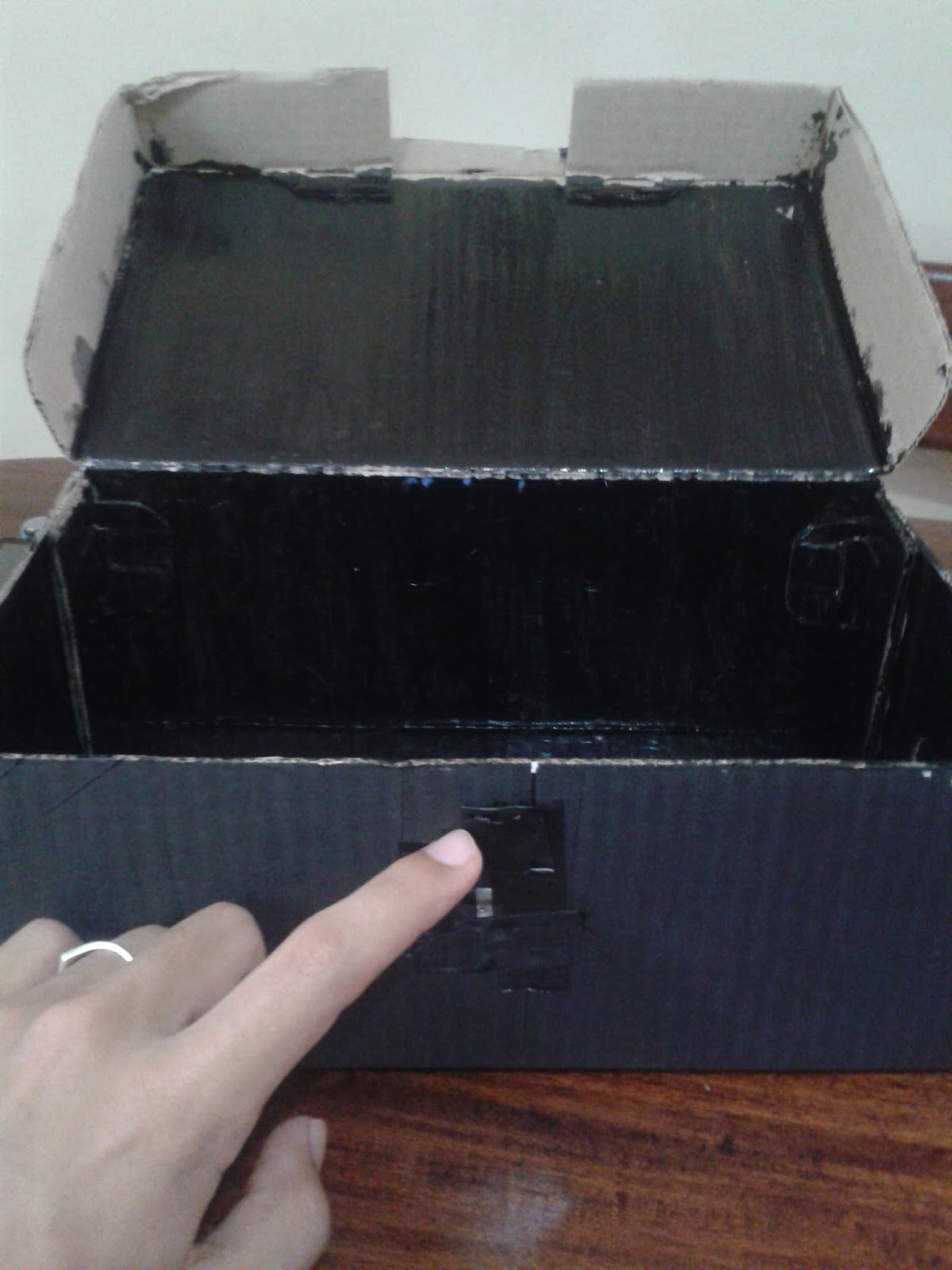
My camera consists of a black shoe box, a small piece of aluminium with a very small hole in it, and black tape. The box is the camera itself, the piece of aluminium with the small hole is the lens, and the tape is the shutter. My camera captures light by only letting in the light that goes through the lens. That way, when the shutter is closed, no light can enter the camera. As you can see in my Ray Diagram, the image focused by the lens appears inverted on the photographic paper inside the camera.  Each point of the image emits light, and the beam of light from that point passes through the lens and creates a point of light on the photographic paper at the back of the shoe box. All of the points in the image do that at the same time, so an entire image, in focus, is created on the photographic paper.

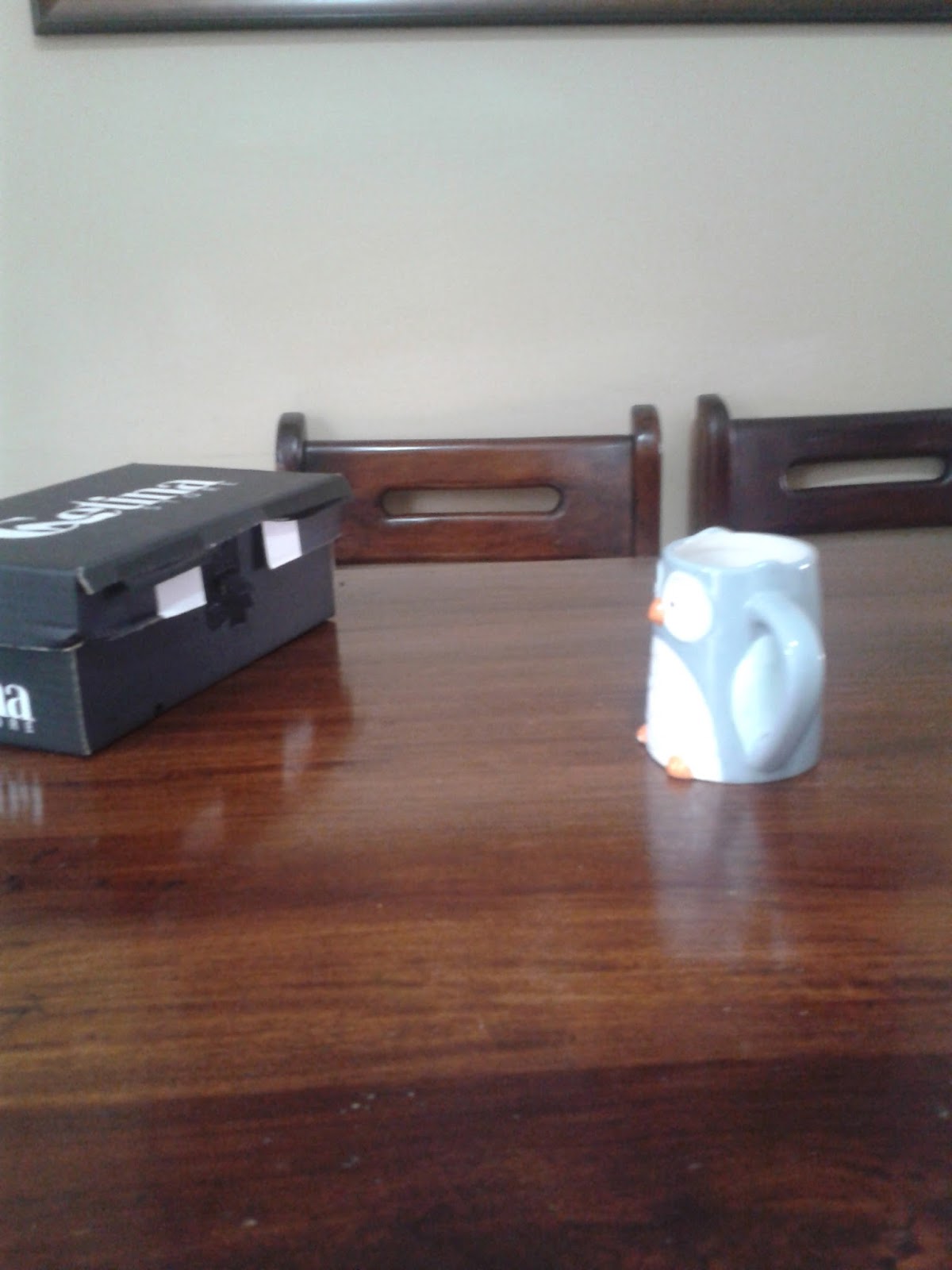
My camera absorbs the light that comes from the sun acting as a particle, given that it refracts and bends to be able to go through the lens, and once inside it acts as a wave, creating interference patterns to form a picture. The picture I was going to take with my camera was of a jar shaped as an owl. 

My camera uses refraction to “bend” the rays of light that are reflected from the image I will photograph into the camera through the lens. The inside of my camera is painted black. This is because black does not not reflect light, unlike all the rest of the colors.

The size of my camera is 27.5 cm (length) x 17.5 (width) cm x 10.5 cm (height). The distance from the lens to the photo paper is 17.5 cm. The distance from the ground to my pinhole is 5.5 cm. The jar I am going to photograph is 11 cm tall, so if I created similar triangles, the equation to calculate the minimum distance needed so that the whole jar would appear in the photograph would be: Distance from the ground to pinhole / height of the camera = height of the jar / X (5.5/10.5=11 cm/X), where X is the distance between the back of my camera and the front of my jar. Since X=35 cm, the minimum distance between my camera and my jar should be 24.5 cm.

20161215_110436.jpg
20161215_123351.jpg


Using the Pythagorean theorem, I can calculate the hypotenuses of these triangles: The smaller triangle (from the back of the camera to the front of the camera): 17.52+5.52=336.5 = 18.34 cm. And the bigger triangle (from the back of the camera to the front of the jar): 422+112 =1885= 43.41 cm. I can also use tan-1 of (5.5/17.5) to find the angle of the light hitting the back corner of my camera, which is 17.44o. To find the angle of the light ray and the jar at the left corner of the drawing, I use tan-1 of (42/11), which is 75.29o.


Unfortunately, after finishing my pinhole camera and making all of the right measurements, I encountered some problems. For instance, there is no photo paper for sale in my city (Guayaquil, Ecuador) unless I were to buy a very very big roll, nor could I find the necessary chemicals to transform my picture from a negative image to a positive one. This meant that I would not be able to take the actual picture. However, I would like to emphasize that even though I didn’t take the photograph, I predict that once someone has already taken their photograph and removed the photo paper, the photo paper will be hot, and this proves one of the main and basic principles we studied in this unit: light = energy.

However, I am more than proud of all of the things I have learned in this course so far, and I am very happy to say that I am now capable of making a camera of my own, knowing all of the science behind it!

Here are some pictures of my camera and the jar:

20161215_135242.jpg

20161215_135309.jpg

20161215_135331.jpg

This is a final photograph of what my picture would have looked like using the pinhole camera:
20161216_141144.jpg

Wednesday, December 14, 2016

"Social Action" Course

I am taking a course called “A Nation’s Argument”, and this is my first Action Project. In this Action Project I have to create my own Declaration of Independence that focuses on a proposal of an Independent Study in addition to all of the courses my school (GCE Lab School) offers. In order to be able to do this I had to study two different Declarations of Independence, from USA and The Democratic Republic of Congo. I also interviewed a friend who has fought for the respect of human rights in Ecuador throughout most of her life. This helped me have a better view of reality itself, concerning human rights and the way humanity approaches them. I also learned about a very special word: unalienable.


I declare that there be an Independent Study called “Social Action” in which students learn how to apply the knowledge acquired in school towards the betterment of their own neighborhood. Service is part of our everyday lives. It is something that helps us forget about ourselves, makes us happy and permits us to learn from others. Service gives meaning to what we study by seeing how it can be applied to improve people’s lives. For these reasons I believe that service is imperative for every single human being.


The purpose of this independent study course, “Social Action”, is to use the Action Projects we have developed in school to improve the atmosphere in which we live.

Content
  • In this course we will learn to interpret the signs of the times to understand the needs of our communities
  • This course starts with an introduction, where students learn about the importance of helping their community, and of how it should be done for it to be most effective.
  • We will learn how to have meaningful conversations with a variety of people in our communities to learn from them and be able to serve them better
  • We will learn how to recognize and apply certain concepts like the search for truth, beauty and prosperity to our surroundings.
Logistics
  • This course is to be given at the beginning of each year, every year. It consists of a short study phase at the beginning of the school year to study the introduction, and an implementation phase of the Action Project itself, which lasts about 5 months. 
  • Halfway through the year at the latest, students should have already chosen an Action Project they have developed to start working on.
  • The Action Projects chosen must be from that same year.
  • The reason of why this course is so long (5 months on the Action Project only!) is because the key to learning through the Action Project  is to give it time to develop. While we are developing our project in our communities, we are constantly implementing and learning from each experience we have. I have chosen this because I believe that the only way to learn how to really create a positive influence on people is through constant action sustained over time.
This course has many different options of coursework, students can choose any Action Project they have developed so far (halfway through the year).This course is to be offered at the beginning of the GCE program, to continue throughout the whole program, until the very end; this way students would always have to mold at least one of their Action Projects in a way where they could use them for the service of their community. Students are to choose one Action Project they have developed that year, internalize and reflect on its purpose, and think of ways of using it for the betterment of their community This is to be done every year. The only requisite is to use their Action Projects in a positive way of action towards their community by developing an organized project(s). The Guiding Question for this course will be “How can I use the Action Projects I have developed so far this year to help my community overcome their issues and progress both spiritually and materially?”

I would like to say that among my unalienable rights, I have the right to study and learn. Therefore I think that with this course, I will be fully exercising this right, by both being able to take all of the apprenticeships that I have gained from the other courses I have studied and putting them in action by helping my community, and understanding the reality of other people’s lives so that we can help them better. It is true that we can serve others without linking that service to what we study, but our service becomes more effective when we learn to apply science to help resolve community issues. I believe it is necessary for me to write this Declaration because this way, students may be able to exercise their unalienable right to study and learn through Social Action, helping the community they live in,  learning by being in constant action to help resolve the issues their community is facing, and thus influencing their community in a positive way. I think that the purpose of school is to exercise the ability of both children and youth to reason in the most essential sciences and arts, permitting them to take these apprenticeships to real-life situations. I would like to emphasize this last phrase, “take these apprenticeships to real-life situations”, given that I consider this to be of utmost importance, for it is the difference between studying only and learning. School is a place for students and teachers alike to progress both materially and spiritually, and I believe that the Social Action course would thereby fit in our school curriculum perfectly.

Course objectives: By taking this course students will...

  • Constantly seek to understand the issues that affect their neighborhood.
  • Consciously identify ways their action projects can be potential small development projects.
  • Develop their Action Project even further, to respond to the needs they have detected in their communities.
  • Communicate their achievements in their school blog.
Resource List

For my course I will need a teacher, a workshop/classroom, and a study guide that they can work in with Google Drive, where students may write notes of how their project is developing for their teacher to see. 


Premise 1: Service is essential in our everyday life.
Premise 2: Our knowledge achieves its highest purpose when used to help others.
Premise 3: All of the action projects in GCE courses can potentially help students fulfill the highest purpose of education.


Conclusion: Therefore, students should take this course to help others in an organized and efficient way by applying the Action Projects they have developed throughout their courses to projects that help respond to their neighborhood’s issues.


I hereby declare that there be an Independent Study where students can learn to use the knowledge they have acquired in school to help others. For what I believe is an unalienable right I declare this to the head board members of GCE and anyone who stands opposed to this idea.


Saturday, October 29, 2016

The Silver Bullet bicycle

I am studying a course on Design and Engineering, and this is my last Action Project. The purpose of this Action Project is to create the ideal bicycle for a Chicago commuter. There are some specific design elements, such as the gear ratios and safety features that can differ depending on the user, and I had to thoroughly study my user in order to deliver to her the best commuting bike that will satisfy all of her needs.

In this unit I learned a ton! We learned about wheels; how they have permitted a better form of transportation, and thus united countries and whole cultures. Later we focused on a specific vehicle: the bicycle. Bicycles share with us many liberating possibilities, for example they permit us to cover 3 functions: We can move from one place to another easily, while respecting nature and exercising our bodies.  I also learned about all the different ways that wheels are used around the globe, and of how they really work. I thoroughly studied the wheel and axle, the pulley, and about gears. Later through the unit, we started concentrating more on bicycles. From researching modern bikes I learned that it there are very interesting and innovative designs which keep a bike safe and locked, for example having the handlebar be a lock as well. I also learned that there are other cleaner and better designs of bike chains, which actually don’t use chains at all but rather carbon and plastic. These bike chains don’t need lubrication, and are also silent when riding.

I interviewed a friend of my dad’s called Chris Haskell and I found the way he described how to choose a good saddle for a bike very interesting. He said that “The wings of the saddle have to meet you on your sit bones” . He also gave an example of why saddles need to be hard, where he asked me to “Imagine rubbing your fingers across a smooth surface, like a piece of tile. You can rub your fingers across a piece of tile for a long time and your fingers will not get hot. But if you get your fingers and you rub them across your sheet on your bed, it doesn’t take very long before your fingers get very hot. This is because soft material creates more friction. This is why your saddle needs to be hard.” More friction equals more work for the same speed.

Going back to my Action Project, I designed my bike for a specific user/commuter. Her name is Malia. She is 15 years old, and lives in Logan Square Chicago. She lives 5 miles away from school, and her road to school is filled with access ramps and potholes. She needs a bike with several gear ratios, that will help her not get tired in her 5 mile ride, that will make her feel comfortable even when going up and down access ramps and over potholes, and that will provide extra space for her to carry groceries, school books, and lunch box.

Here is a map of her approximate route:


According to Google maps, it will take her approximately 30 minutes to get to school everyday. Her average speed on her commute will be of about 10 miles per hour, or 4.4704 meters per second.

Malia is looking for an easy, comfortable ride to school and back home. However, if she for some reason is in a hurry, she would like to go faster. So she would prefer a mid-sized cog in the front (39 teeth), and three different-sized cogs in the back (15 teeth, 16 teeth, and 17 teeth).  This way she could use the 17 teeth cog to go up the ramps at the subway stations, the 15 teeth cog to reach high speeds on the road and down slopes, and the 16 teeth cog to cruise. I chose only 3 different gear ratios so that it would be simple for Malia to use, yet productive, fulfilling all of her needs. I chose these specific cog sizes for Malia, her approximate weight being 125 pounds and her preferred travel speed being roughly 18 km/h on her mostly flat journey.
The gear ratios for these sizes would be:
15 teeth 2.6/1
16 teeth 2.4/1
17 teeth 2.3/1
These are exactly the same sizes as the 3 middle gears of the small front gear of the Shimano Sora Gear Shifting  System.

MY BIKE

My bike is a hybrid between a road and a mountain bike, customized for the commuting needs of my user. It has a light aluminium body, with suspension forks on the front wheel, and thin wheels that are both fast and resistant. Similar to the Denny Bike, it comes with an integrated removable handlebar locking system, as well as racks with a flexible storage system in the front AND back, as part of the frame. It also has a fully-integrated turn signal, head and brake lights system, with its turn signals activating with only the touch of a button (pushing the brake handles out instead of in; they turn off with clicking again)  for safety. This is very important, given that she often rides her bike back home at night. My bike includes a removable battery for charging the lighting system, as well as a minimal fender that removes water from the tire itself. Finally, it also comes with a gear shifting system, with the 3 different speeds that Malia will need for her commute. The radius of my bike’s wheels is  14.5 inches long, and its diameter 31 inches.

My bike is better than the competition, because with its light and resistant wheels, Malia won’t have to worry about getting late to school or work ever again. The wheels, along with the different gear speeds, allow the user to reach high speeds with less work than usual.The flexible storage system in the front and back of the bike that are part of the frame itself also allow you to take both big and small delicate objects on your trip with safety. Also, its light suspension forks on the front wheel permit you to have a smooth ride through the usual potholes and ramps in the city. My bike’s unique locking system allows Malia not to worry about her bike’s safety at school, the library or the grocery shop. My bike would demonstrate Potential Energy when at the top of a hill, and Kinetic Energy when Malia is riding the bike to school, to the food market, or back home.

Malia, my user, lives 5 miles away from school, and will have to travel that distance and back every week day. She will have to go on the elevated 606 trail and Milwaukee Ave. This means that she will have to go up and down access ramps, and she will encounter potholes on the Avenues; she also goes grocery shopping on her way back to school. My bike’s lightness and gear-shifting system reduces the amount of force needed to travel her 10 daily miles, including going up and down access ramps. Also, potholes won’t be a problem thanks to the suspension forks on the front wheel. While she is at school and shopping, she can use the bikes handlebar self integrated locking system to keep it safe from someone stealing it. Also, the flexible storage system in the front and back of the bike that are part of the frame will allow her to ride comfortably back home with her groceries. She also needs to have a safe trip back home after school, sometimes at night. Because of this, my bike comes with a fully-integrated, turn signals, head and brake lights system, with its turn signals activating with only the touch of a button, so that cars and other commuters may see her. Given that the circumference of the wheels of my bike is 91.1 inches., they will rotate a total of  8832.84 times before she gets to her destination.


When making my bike I kept in mind all of  Malia’s needs, as well as her age and the distance she will be traveling every day. I also kept in mind all of the things I learned about wheels, axles, pulleys and gears in my Internal Investigation, as well as all of the personal experiences riding bikes that my interviewee shared with me, and the things that he had learned of over time that he thought made his bike experience more productive. Malia should trust in my design because the accessories it features satisfy all of her needs.

One of the obstacles that I ran into when making this Project was that I didn’t (and still don’t) have any experience commuting with a bike. Commuting with bikes is not really part of the culture here in Ecuador. This is probably because it is very hot and humid all year long and people don’t want to get to work sweaty! Also, there are no good bike paths in the city where I live (Guayaquil), and drivers do not take bicycles into consideration. So this forced me to really try to get into the mind of my interviewee, Chris Haskell, who is a faithful commuter and biker who rides approximately 200 miles per week. Another obstacle that I ran into was that most of the math that I learned in order to achieve this project was very new and quite hard for me! But with the help of Khan Academy, I understood much faster than usual.

I am proud of all of the knowledge that this unit has gifted me. One of the things that I learned which I value most is that I was able to realize, by studying different bike organizations, how much a bike can really help someone. In rural communities for many people, bikes are essential in their everyday tasks! This motivated me a lot to learn more about how I can improve bikes and make them more accessible.

Works Cited:


Denny Bike official website http://www.dennybike.com/#about
My interview with Chris Haskell on the phone, October 2016

Wednesday, October 26, 2016

La Limpieza Podemos Alcanzar


I am Studying a course about Rhetoric, and this is my third Action Project. It consists of making a piece of art to address a social issue that is important to me. I decided to make a song, which addresses the issue of the lack of cleanliness in my town, Chongón,Ecuador. The name of my song is “La Limpieza Podemos Alcanzar” (We Can Achieve Cleanliness). It is a “Cumbia” song, which is a Latin American rhythm that is popular in  Chongón.

There is a certain neighborhood inside  Chongón called San Geronimo 2, which I visit a lot given that I have a children’s class there once a week, in which I teach kids from 6 to 8 years old about spirituality and values.I have started to realize that there are some problems that the neighborhood has that the locals have never really set their mind on changing because they may seem quite unimportant. However, I have also started to realize that these unattended problems affect not only the children in my class, but the whole neighborhood in general! So I decided to break the sound barrier on one of the problems that I feel is affecting San Geronimo 2 the most: the lack of cleanliness.

My thesis statement

I made my song as a “Cumbia” so that it would attract the locals of San Geronimo 2, and I wrote simple lyrics so that it would be easy for people to sing. My goal in making this song is so that the locals of San Geronimo 2 may open their eyes to this problem, and realize that it is affecting them both emotionally and economically, so that they may get together and work towards reversing this problem.

Here is a recording of the song I made:


Here are the lyrics of the song:

La Limpieza Podemos Alcanzar

Al caminar por mi bello barrio
Gente amable sonrie con fulgor
Niños jugando en el parque veo
Madres y padres juntos van tras ellos

Pero el agua en las calles muy sucia está
Y los niños jugando se mojan sin parar
Debemos limpiarlas pa’ encontrar sanidad
(Pues) Los niños se enferman y para el doctor no hay más

CHORUS
El fuego de la unidad
Se enciende en todos al cantar
La limpieza podemos alcanzar 
Pero todos debemos apoyar

Mi barrio ahora más limpio está 
Y el resultado alegra a los demás
Niños más sanos juegan juntos sin temor
Padres sin la más mínima preocupación

Pero las construcciones en las calles siempre están
Y el polvo que crean a los pulmones van 
Debemos limpiarlas pa’ encontrar sanidad
(Pues) Los niños se enferman y para el doctor no hay más

CHORUS
El fuego de la unidad 
Se enciende en todos al cantar
La limpieza podemos alcanzar 
Pero todos debemos apoyar (Bis)

Here is a rough English translation of the song:

We can achieve cleanliness

While I walk through my beautiful neighborhood
Kind people smile with fervor 
I see kids playing in the park
Mothers and fathers together looking after them.

But the water in the streets is very dirty
And the kids playing fall on them
We need to clean the streets to achieve sanity
Because the kids are getting sick and there is no money for the doctor.

CHORUS
The fire of unity
Lightens in us all as we sing
We can achieve cleanliness
But we must all give a hand

My neighborhood is now much cleaner
And this makes everyone happy
The kids play with no fear 
Parents with no worry

But there is always constructions in the roads
And the dust they create go directly to the lungs
We must clean them to achieve sanity
Because the kids are getting sick and there is no money for the doctor.

CHORUS
The fire of unity
Lightens in us all as we sing
We can achieve cleanliness
But we must all give a hand (BIS)

My Artist Statement

Here are some things I have observed in San Geronimo 2:
  • My kids often come with no shoes or no shirts to my children’s class.
  • The streets of San Geronimo 2 have been in “repair” for the last 6 months. The work is very slow given that workers don’t get paid enough and on time. This creates a lot of dust, and this brings diseases.
  • Much, if not most of the wastewater that comes from the houses of San Geronimo 2 empties out into the street. San Geronimo 2 is situated on flat ground, and the wastewater accumulates and becomes the focus of mosquitoes that can carry a variety of diseases. 
  • The wastewater accumulated in the streets makes the whole town smell terrible, and children that play in the street often fall and get wet with this water. This also brings diseases.
“Breaking the sound barrier” means To bring to light problems/facts that go unheard, which often turn out to be very important. With that said, I believe that my song breaks the sound barrier because it talks specifically about two of these facts: the wastewater and dust that accumulates in the streets and their consequences. This is a topic that no one talks about or pays attention to in general in San Geronimo. I decided to start the song by naming all of the good things that San Geronimo 2 has to share, and later I introduce the wastewater problem and its consequences. Then the chorus says that the solution to these problems can be reached if we decide to unite and help clean our neighborhood. Next, it talks about how I see San Geronimo 2 better already, but that the dust from the street repairs is accumulating and affecting us all physically and emotionally. And finally, I repeat the chorus twice.

I used a metaphor to describe unity as a “fire” that lights in all of our hearts when working in harmony towards the improvement of our neighborhood. I also used rhymes throughout the whole song to make it sound much more attractive and easier to sing.

With this song I hope to make the people of San Geronimo 2 see that their neighborhood is full of beautiful people and also potentially a beautiful place, and it is because of this that they should work together to make it better yet. I also hope that they may see that they are presently living the consequences of the lack of cleanliness, and it is bringing them much grief and economic depression. I will share this song with the president of the neighborhood. I will suggest that he organize a cleaning campaign and offer to invite the children from my class to participate. I will also sing the song with the children from my class.